

Description
Signal
Nr. 9 (D) — 10. August 1940
Publisher: Deutscher Verlag, Berlin SW 68, Kochstrasse 22–26 | Editor-in-Chief: Harald Lechenperg | Frequency: Fortnightly (erscheint alle 14 Tage) | Copyright 1940 by Deutscher Verlag Berlin
Pages scanned: 48
Overview
This triumphal issue pivots from the campaign in France to its victor’s welcome home, centering the Paris victory parade and the Berlin march-in under the Brandenburg Gate, while simultaneously opening a new theater with Italian air operations over Malta and North Africa, and filling the rear half with the cultural self-portrait of a confident Reich at leisure.
Articles and Features
Die große Flucht / The Great Flight (Exodus)
A political essay and photo essay arguing that the mass civilian flight southward through France in May–June 1940 was the direct result of irresponsible Allied propaganda rather than genuine fear of German troops, contrasting it unfavorably with all previous European population movements including Napoleon’s scorched-earth retreat from Moscow.
“…Ein Sozialstaat von höchster Kultur” / “…A Social State of the Highest Culture”
From the Reichstag speech of Adolf Hitler, 19 July 1940 (photo feature, no byline)
A photo feature on the 1940 Bayreuth Festival and the Great German Art Exhibition in Munich, illustrating the quote from Hitler’s Reichstag speech and showing wounded soldiers and armaments workers as the wartime audience for Germany’s premier cultural events.
Bis hierher… / Thus Far… (To the Spanish Border)
By H. R. B. (initials only — Signal editor Harald Lechenperg writing in first person)
A first-person account, framed as an almost surreal diplomatic adventure, in which Signal’s editor and a colleague drive through unoccupied south-western France toward Bayonne and Biarritz at the moment German troops are marching in, encountering confused French soldiers who have no idea the German advance has reached them (continued p. 35).
Mit dem Liktorenbündel / With the Lictor’s Bundle (Italian Air War)
(Italian Regia Aeronautica photo report)
A six-page illustrated report on Italy’s air war across the Mediterranean theater — bombers serviced at a field airfield hidden in an olive grove in southern Italy, arming of bombs in ancient Sicilian stone quarry halls, combat photographs of bomb explosions on British warships at sea, and aerial imagery of Fort Sollum on the Libyan border after Italian bombing raids.
In 25 Sekunden — Mit Sturmbooten über den Oberrhein gegen die Maginot-Linie / In 25 Seconds — With Storm Boats Across the Upper Rhine Against the Maginot Line
Photography: P.K. Grimm
A minute-by-minute assault narrative, centered on the battered but tenacious Major Gantke, recounting the pioneer storm-boat crossing of the 200-meter-wide Upper Rhine at 10:09 AM under direct Maginot bunker fire, the bunker-by-bunker destruction using flamethrowers and demolition charges, and the construction of the pontoon bridge that followed within hours.
Graf Ciano besucht die deutsche Front im Westen / Count Ciano Visits the German Western Front
(diplomatic photo feature)
A photo portrait of Italian Foreign Minister Count Galeazzo Ciano’s tour of the former Western Front — flying over the battle areas, inspecting Verdun’s fortifications with Generalleutnant Weisenberger, surveying the Dunkirk beaches, examining a Heinkel He 111 at close range, and meeting the Hungarian Prime Minister Graf Teleki at the Chiemsee after the Munich discussions.
Der Weg nach Dünkirchen — Über die Struktur der englischen Gesellschaft / The Road to Dunkirk — On the Structure of English Society
By Dr. Ernst Lewolter
A long sociological essay arguing that England’s rigid class structure — illustrated by the Waterloo Station platform where gentlemen and workers briefly mix — condemned it to Dunkirk, because the “Gentleman” code that governs the ruling class places social ritual above rational reform, leaving the nation unable to adapt to new forms of warfare.
Der Schuß ohne Kugel / The Shot Without a Bullet
A popular-science feature presenting a new German toy gun that uses a battery-powered light projector inside the stock to project a target disc on the wall and mark a ‘hit point’ when the trigger is pulled, allowing realistic target practice without ammunition or risk.
Vormarsch — In Paris / Advance — In Paris
A four-page color spread documenting the German entry into Paris on 14 June 1940: exhausted German soldiers resting on artillery limbers in a Paris street, motorcycle dispatch riders orienting themselves at a crossroads, a crashed Allied aircraft on a canal embankment, and horse artillery moving up the tree-lined Avenue Foch toward the Arc de Triomphe.
Trotzdem: Das Leben ist schön! / Nevertheless: Life Is Beautiful!
By Walther Kiaulehn
A feature-length eyewitness piece set in occupied Brussels, presenting the city’s night life, street markets, and NSV refugee relief operations as evidence of normalcy returning under German administration, focusing on a nameless Belgian patroness who organized refugee aid and an encounter with a young Danish mother in the refugee hall at the South Station.
Neue deutsche Plastik / New German Sculpture
A photo feature presenting works from the Berlin Künstlerhaus sculpture exhibition, including Prof. Arno Breker’s ‘Bereitschaft’ (Readiness) and ‘Auszug zum Kampf’ relief, Prof. Georg Kolbe’s ‘Amazone’ bronze, Prof. Fritz Klimsch’s ‘Olympia’ bronze, and a relief by Prof. Josef Wackerle destined for the Obersalzberg Führerhaus.
Er war gegen seine Zeit… / He Was Ahead of His Time…
By Prof. Heinrich Hunke, President of the Advertising Council of the German Economy
A two-page biographical tribute to Ernst Abbe (1840–1905), physicist and social reformer, crediting him with transforming Carl Zeiss from a workshop into a global optics enterprise and pioneering the eight-hour workday, profit-sharing, and company-financed worker housing long before these became state policy — presented as a proto-National Socialist entrepreneur.
Tänze und Kleider / Dances and Dresses
A color spread from Berlin’s traditional Funkturm flower show, showing women in summer evening gowns on a runway and gymnasts in yellow costumes waving red fabric banners across the open-air stage.
Die Frauen der Soldaten: Ihr Lebensstandard bleibt erhalten! / Soldiers’ Wives: Their Standard of Living Is Maintained!
A detailed social-policy feature explaining the German wartime family allowance system through six anonymized case studies — a factory worker’s wife, a surgeon’s family, a tram conductor’s household, an airbase radio operator’s fiancée, an artillery regiment’s cook’s wife, and a farmer’s family — showing how state support scales to the soldier’s pre-war income.
Aus der Hexenküche…für schöne Frauen / From the Witch’s Kitchen…for Beautiful Women
A two-page feature on the science of perfumery, presenting the ‘Duft-Cocktail’ concept — that blonde, dark-haired, and red-haired women instinctively prefer distinct fragrance profiles (fresh/sporty, sweet/oriental, herbal/aromatic) — illustrated with elaborate botanical diagrams of head, heart, and base note combinations.
Zange mit Augen und andere wissenschaftliche Neuigkeiten / Forceps with Eyes and Other Scientific News
A science notes page covering three items: a new periscopic surgical instrument allowing surgeons to view and control an internal forceps through a sealed body cavity; a Berlin researcher’s finding that human tissue contains measurable trace mercury even without dental amalgam; and a Vienna study confirming that freeze-preserved foods retain Vitamin C fully after one year.
Sven Hedin korrigiert die Landkarte / Sven Hedin Corrects the Map
A two-page feature on the Swedish explorer Sven Hedin’s ongoing compilation of a new Central Asia atlas, explaining the cartographic process of reconciling conflicting survey data from multiple expeditions — rivers with changed courses, cities displaced, mountains renamed — illustrated with before-and-after map excerpts of the Tarim Basin in East Turkestan.
Rekorde — Höchstleistungen deutscher Sportler / Records — Peak Performances of German Athletes
A two-page sports photo feature celebrating recent German athletic records set during the war year: Anni Kapell’s 200-m women’s swimming record in Düsseldorf; Max Syring’s 10,000-m national record in Jena; Hans Clausen’s middleweight barbell record in Hamburg; the Charlottenburg 4×200-m women’s relay team’s German record; and 14-year-old Vera Schäfer-Kordt’s 800- and 1000-m freestyle records.
Advertisements
p. 2 (left) — Arado Flugzeugwerke GmbH (Potsdam): Arado Ar 96 B multi-purpose trainer and light combat aircraft
p. 29 — Mercedes Büromaschinen-Werke AG (Zella-Mehlis/Th.): Full product line — portable, office, and electric typewriters; adding machines; calculating machines; accounting machines
p. 31 — Maschinenbau und Bahnbedarf AG, vormals Orenstein & Koppel (Berlin): Locomotives, wagons, excavators, ships, aircraft — MBA Konzern
p. 34 (left) — Telefunken: Allstromsuper 054 portable radio receiver
p. 35 (lower) — Queisser & Co., K.G. (Hamburg 19): Jod-Kaliklora iodine toothpaste
p. 36 (lower) — C. Lorenz AG (Berlin-Tempelhof): Großrundfunksender (large broadcast transmitters) and wireless communications equipment
p. 47 — Mannesmannröhren-Werke (Düsseldorf): API-standard drill pipes and drill-string tubes
Color Plates Summary
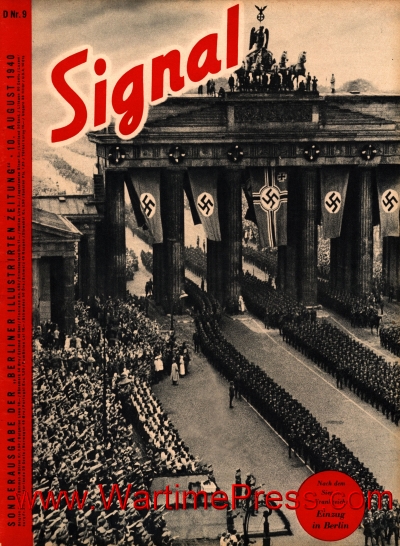
• Cover — The Brandenburg Gate draped in five massive swastika banners, seen from above a packed ceremonial crowd; a lone officer at a podium addresses the massed formation on Unter den Linden as troops march through the gate after the victory in France. Cover circle reads: ‘Nach dem Sieg in Frankreich: Einzug in Berlin’ (After the Victory in France: March-in to Berlin). [COLOR]
• p. 9 — ‘Italienische Bomber über Malta’ (Italian Bombers over Malta): Full-page color gouache painting showing a formation of Italian Savoia-Marchetti S.M.79 bombers, marked with the fasces emblem, diving over the island of Malta through flak bursts, with Grand Harbour and the sea below. [COLOR ARTWORK] ★ MOST DRAMATIC PLATE — the operatic composition, vivid blue sky and green island contrasting with the diving bombers and shell-burst white, makes this the most visually striking image in the issue.
• p. 10 — ‘Schwerer Beschuß auf einem Panzerwerk der Maginot-Linie’: Full-page color photograph of a German soldier prone in a wheatfield, silhouetted from behind, while a massive orange-black explosion column rises from a fortification 200 meters ahead. [COLOR]
• pp. 23–26 — ‘Vormarsch — In Paris’ four-page color spread: p. 23 shows German infantry at a railway embankment under fire, a wrecked Allied biplane on a canal bank, and motorcycle dispatch riders consulting a map; p. 24 shows exhausted soldiers resting on artillery wheels in a Paris street on 14 June; p. 25 shows the cavalry trumpeters on grey horses at the Arc de Triomphe; p. 26 is an aerial view down Avenue Foch during the victory parade. [COLOR]
• p. 39 — Perfume feature colour plate: Studio portrait of three women — a redhead in floral dress, a dark-haired woman in white, and a blonde in silver satin evening gown — posed around a fireplace with daffodils and candles, illustrating the three fragrance personality types. [COLOR]
• p. 40 — ‘Tänze und Kleider’ (Dances and Dresses): Color spread from the Berlin Funkturm flower show — top image shows a line of gymnasts in yellow tops waving long red fabric banners across a green lawn; bottom image shows eight women in pastel summer evening gowns on a podium runway. [COLOR]
• Back cover (p. 48) — ‘Husarenstück eines deutschen Panzers’ (A German Tank’s Hussar Coup): Full-page charcoal/ink illustration showing a German Panzer ramming through the ground floor of a French farmhouse at full speed during the advance on St. Valery, with British MG crew and ceiling beams flying apart above the tank’s turret (signed, artist illegible, dated ’40). Red border frame. [ILLUSTRATION]