

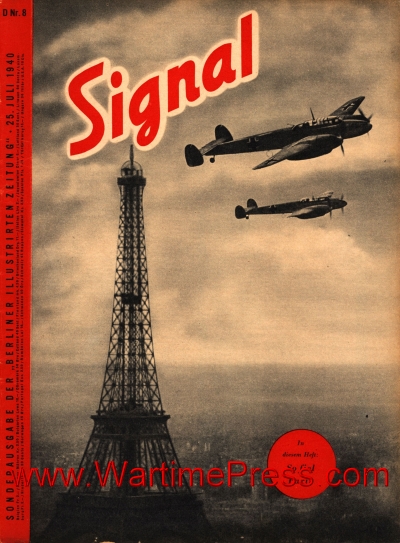
Description
Signal
Nr. 8 (D) — 25. Juli 1940
Publisher: Deutscher Verlag, Berlin SW 68, Kochstrasse 22–26 | Editor-in-Chief: Harald Lechenperg | Frequency: Fortnightly (erscheint alle 14 Tage) | Copyright 1940 by Deutscher Verlag Berlin
Pages scanned: 48. Instant PDF download.
Overview
This landmark issue centers entirely on the fall of France, combining the eyewitness account of the Paris capitulation with strategic analyses, Maginot Line assault reporting, a tribute to the Italian Marshal Italo Balbo, and an extensive illustrated feature on the motorization of the German Army — all framed by some of the most dramatic color photography yet published in the war.
Fallen / Memorial
Page 17 carries an obituary and memorial spread for Italian Air Marshal Italo Balbo, killed in action over Tobruk on 28 June 1940. The piece commemorates his legacy as aviator, colonial governor of Libya, and Fascist organizer.
Marschall Italo Balbo — Italian Air Marshal, Governor of Libya
Articles and Features
Vom Kriege / On War
A sweeping military-political analysis arguing that Germany’s campaigns in Poland and Norway served as rehearsals — tactically and logistically — for the decisive offensive against France, Belgium, and the Netherlands, and refuting Western assessments that Germany lacked trained offensive capability.
So fiel Paris / How Paris Fell
By Dr. Wilhelm Ritter von Schramm (Ordonnanz-Offizier / Ordnance Officer)
A first-person, hour-by-hour account — told from within the German parliamentary delegation — of the advance on Paris, the ceasefire approach, the negotiations at the Chateau d’Ecouen on 13–14 June 1940, and the moment Paris capitulated without a shot (continued from p. 7 to pp. 32, 33, 46).
Panzerwerk 696 — 678, 685, 699 / Fortification 696 — 678, 685, 699
No byline (Pionier unit report)
A minute-by-minute assault diary describing how German pioneer storm troops breached Maginot Line bunkers 678, 685, 696, and 699 on 19 June 1940 using demolition charges, flamethrowers, and direct fire, supported by divisional artillery and Stuka dive-bombers.
Wir setzten auf die PS! Die Motorisierung des deutschen Heeres / We Bet on Horsepower! The Motorization of the German Army
By Major Dr. Springer
A comprehensive illustrated history — from Daimler and Benz in 1885 through the 1940 Blitzkrieg — tracing how Germany systematically motorized its army while the West underestimated the military potential of the automobile, the synthetic-rubber Buna program, and standardized vehicle types.
Marschall Italo Balbo / Marshal Italo Balbo †
An obituary tribute profiling Balbo’s career as Atlantic squadron commander, Libya’s colonial governor, and early Fascist leader, illustrated with archive photographs of his 1933 transatlantic squadron flight and a final photograph taken while he was issuing flight instructions to Italian pilots in North Africa.
Dünkirchen / Dunkirk
A two-page color photo spread presenting the destroyed harbor and streets of Dunkirk, with captions documenting a German propaganda cameraman filming the British evacuation scenes and a wrecked Allied warship sunk in a Stuka attack.
Ein schweres deutsches Geschütz / A Heavy German Gun
A color photo feature showing a massive German long-range artillery piece being serviced by shirtless crew in a forest emplacement, illustrating the role of heavy batteries — including railway guns over 21 cm caliber — in targets beyond Luftwaffe reach.
Der kleine und der große Flieger / The Small and the Large Flyer
A color double-page comparing a trained falcon sitting on a Luftwaffe pilot’s wrist aboard a fighter named ‘Sepp’ with ground crew boarding a large Dornier flying boat, symbolizing German air mastery from smallest to largest.
Dienstfrei in Calais / Off Duty in Calais
A color photo feature showing German soldiers relaxing on the beaches of Calais — wading, sunbathing, and playing with French civilians — after weeks of hard campaigning, conveying an image of normalcy in occupied France.
Stürzen und stürzen ist zweierlei / There Are Falls and There Are Falls
A light sports feature on the art of controlled falling in bicycle racing, arguing that professional riders train themselves to relax during crashes — illustrated with a dramatic blurred-motion photograph of a cyclist tumbling at speed.
Die ‘punkthelle’ Berlinerin! / The ‘Ration-Savvy’ Berlin Woman!
Photography by Hanns Hubmann
A photo essay tracking one Berlin woman named ‘Erika’ through a full working week, showing how she navigates wartime clothing rations (Reichskleiderkarte) with style and ingenuity.
Es geht um 3½ Pfund / It’s About 3½ Pounds
A feature on the National Socialist People’s Welfare (NSV) program sending working women to four-week recuperation camps in the Harz Mountains, illustrated with before-and-after weight-gain charts for named participants.
Was würden Sie tun, wenn…? / What Would You Do If…?
By Dr.-Ehrig Wartegg, occupational psychologist, Erfurt labor office
A follow-up to the previous issue’s drawing-completion psychological test, presenting analysis and comparative results from subjects of different ages and vocations, claiming to reveal character type, career aptitude, and inner emotional balance.
Jedes Jahr neu aufgerüstet / Re-Armed Every Year
A nature feature tracing the annual growth cycle of a red deer’s antlers month by month, with photographic sequences from velvet to polished rack, drawing an implicit parallel to German rearmament.
Aufbau / Reconstruction
Brief photographic coverage of Dutch conductor Willem Mengelberg rehearsing with the Berlin Philharmonic for a sell-out Tchaikovsky concert, paired with images of the Reich Labor Service clearing rubble in war-damaged towns, presented as evidence of cultural and physical reconstruction.
Sie berichten aus Deutschland / They Report from Germany
A two-page portrait gallery introducing foreign press correspondents stationed in Berlin, including Louis P. Lochner (AP), Filippo Bojano (Stefani/Popolo d’Italia), Susumu Ejiri (Japanese Domei agency), Iwan Filippow (Soviet TASS), and others from Spain, Denmark, Sweden, Hungary, and Finland.
In den Straßen der Reichshauptstadt… um Theaterkarten / Queuing in the Capital… for Theatre Tickets
A photo essay and essay on the booming German theatre season 1939/40, arguing that cultural life continues at record attendance despite the war, with coverage of new opera productions in Berlin, Hamburg, Dresden, and Stuttgart.
6 Wochen Krieg im Westen, in 6 Etappen dargestellt / Six Weeks of War in the West, Shown in Six Stages
A full-page oblique relief map of France and the Low Countries with six overlaid front lines from 10 May to 24 June 1940, annotating 1,900,000 French prisoners taken and 792 enemy aircraft destroyed since 4 June.
Advertisements
p. 2 — Wanderer-Werke AG (Siegmar-Schönau): Continental Model 1530 typewriter with rotary card index
p. 31 — Berlin Wintergarten: International variety theatre, 3,000-seat venue, new climate control system
p. 32 (lower) — Mix & Genest AG (Berlin-Schöneberg): Military/commercial telecommunications equipment (Fernsprechen, Fernmelden)
p. 33 (lower) — Seidel & Naumann (Dresden): ‘Ideal’ and ‘Erika’ precision typewriters
p. 34 (lower) — Joseph Vögele A.G. (Mannheim): Road-paving and construction machines, est. 1836
p. 35 (right) — M. Hensoldt & Söhne Optische Werke A.-G. (Wetzlar): Dialyt extra-light binoculars for travel, sport, and hunting
p. 37 (lower) — Queisser & Co., K.G. (Hamburg 19): Jod-Kaliklora iodine toothpaste, physician-recommended
p. 47 — Hilgers AG (Rheinbrohl): Steel construction of all types — bridges, tank containers, canal vessels, galvanizing
Color Plates Summary
• Cover — Two Heinkel He 111 bombers banking over the Eiffel Tower, Paris, with cover circle reading ‘In diesem Heft: So fiel Paris’ (In this issue: How Paris Fell).
• p. 9 (double spread) — Heavy German artillery piece (‘Ein schweres deutsches Geschütz’) with bare-chested crew loading the breach in a forest emplacement; lower image shows fire-control operator with field telephone. [COLOR]
• p. 10 (double spread) — Upper: Luftwaffe pilot in cockpit of fighter ‘Sepp’ admiring a falcon held by a crewman; lower: ground crew boarding a large Dornier flying boat. [COLOR]
• pp. 23–24 (two full pages) — Dünkirchen (Dunkirk): top, color street scene with German propaganda cameraman filming; bottom, wrecked Allied warship in harbor after Stuka attack. [COLOR]
• pp. 24–25 — Two full-page war paintings (gouache/watercolor): p. 24, German tanks entering a burning French town through rubble-strewn streets; p. 25, lone Panzer rolling through devastated village (signed ‘Brütt ’40’). [COLOR ARTWORK]
• p. 26 — ‘Am letzten Tag vor der Übergabe von Paris’ (The Last Day Before the Surrender of Paris): oil tanks burning on the suburban fringe, viewed across a French cemetery with grave crosses in the foreground, massive black smoke billowing into a blue sky. [COLOR] ★ MOST DRAMATIC PLATE — the juxtaposition of cemetery and burning horizon is the single most striking image in the issue; it visually encapsulates the fall of Paris.
• pp. 39–40 — ‘Dienstfrei in Calais’ (Off Duty in Calais): three-page color beach spread showing German soldiers wading, sunbathing, playing football with French locals on a bright Channel beach; p. 40 continues the leisure theme with gymnast doing a handstand and bathers on a German domestic beach. [COLOR]
• Back cover (p. 48) — Full-page strategic map of Britain with German Luftwaffe range arcs and industrial zones highlighted in red, framed by a thick red border with the Signal masthead. [COLOR MAP]