

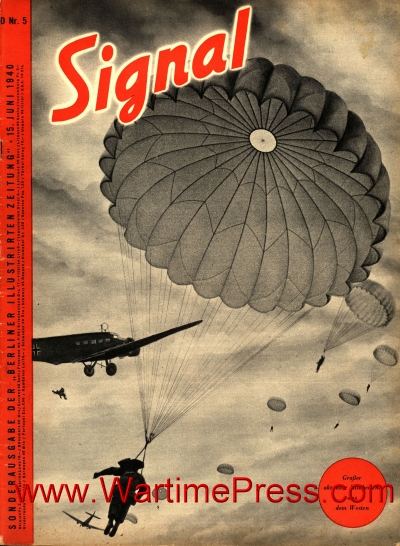
Description
Signal
Jahrgang 1, Nr. 5 • Berlin, Germany • 15 June 1940
Publisher: Deutscher Verlag GmbH, Berlin SW 68, Kochstraße 22–26 | Chief Editor (Hauptschriftleiter): Harald Lechenperg | Frequency: Bi-weekly (erscheint alle 14 Tage)
40 pages scanned
Overview
Signal Nr. 5 is dominated by a single theme: the eighteen-day campaign that crushed Holland, Belgium, and the Allied armies in France, presented in a triumphant, multi-front photo-narrative just days after the Belgian surrender.
Articles and Features
In 18 Tagen: Holland und Belgien / In 18 Days: Holland and Belgium
pp. 2–7 — Opening photo-essay covering the eighteen-day Western offensive from 10 May 1940, tracing the paratroop landings in Holland, the surrender of Rotterdam, the Panzer breakthrough to the Belgian-French border, and the fighting at Sedan through battlefield photographs and aerial imagery.
Pages 2–3: B&W — aerial photograph of a destroyed Allied airfield; two photographs of paratroopers exiting a Ju 52 door in sequence. Page 4: B&W — parachutes descending over a Dutch city; supply parachute snagged on a Rotterdam bridge; supply canisters in a street; paratrooper on a rooftop; Rotterdam burning at night; parliamentary officer approaching to surrender the city. Pages 5–6: B&W — Panzer II with infantry advancing through a valley; aerial view of a French tank battlefield strewn with knocked-out vehicles; portrait of a steel-helmeted German soldier; destroyed bridges; shell bursts in Sedan; a burning city street. Page 7: B&W — German infantry assault troops throwing grenades at night; two photographs of half-eaten meals abandoned by fleeing French officers in Sedan’s citadel.
Aus dem Tagebuch eines gefangenen Franzosen / From the Diary of a French Prisoner
Anonymous (French prisoner of war, Parisian lawyer by profession)
pp. 8, 28 (continuation) — Serialized diary of a French POW — identified as a Paris lawyer — covering 5–22 May 1940, recording his growing shock at the speed of the German advance, his disillusionment with Allied leadership, and his capture, presented by Signal as evidence of French military collapse.
Page 8: Three B&W photographs — 20-kilometre column of French prisoners marching; three colonial African soldiers at a German collection point; refugees streaming from Belgium with loaded carts.
Kampf im Vormarsch / Combat on the Advance
p. 9 — Single full-page color photograph showing a German infantry gun crew engaging the enemy at point-blank range from a roadside ditch during the French campaign.
Full-page COLOR photograph — infantry gun crew crouching behind a roadside embankment, gun wheel and breech prominent, smoke rising from a burning building on the horizon; olive-grey uniforms against brown earth and pale sky.
“Westward Ho!” — Korvetten-Kapitän Hartmann erzählt / “Westward Ho!” — Corvette Captain Hartmann Tells His Story
Korvettenkapitän Hartmann (as told to Signal)
pp. 10–13 — Three-page illustrated account of U-boat commander Hartmann’s last patrol — sinking an English cruiser, a freighter, and a 10,000-ton tanker — including the encounter with a lifeboat crewed entirely by colonial sailors from Britain’s empire, narrated in the commander’s own words.
Page 10: Full-page COLOR painting by Hans Liska — U-boat deck at sea with lifeboat of multiracial survivors being pulled alongside; vivid warm tones, red flag, dramatic wave action. ★ MOST DRAMATIC COLOR PLATE. Page 11: B&W — U-boat commander hailing a crowded lifeboat at sea; small portrait of Korvettenkapitän Hartmann in deck gear (Knight’s Cross visible); Hartmann with the lone Norwegian survivor. Page 12: Four B&W portrait photographs of Hartmann in conversation, illustrating his three quoted anecdotes about sinkings and silencing a Norwegian lighthouse. Page 13: B&W — four-frame photo sequence showing a freighter on the horizon, torpedo hit explosion, ship listing and sinking; two B&W photographs of a Norwegian coastal lighthouse being destroyed by shellfire.
Wunder in Holz — Der Weg vom Baum zum Bein / Wonder in Wood — From Tree to Stocking
pp. 14–15 — Industrial photo-feature tracing the manufacture of rayon (Kunstseide) from beech-tree cellulose through eight numbered factory stages, celebrating German synthetic textile production as an economic achievement.
Page 14: Eight B&W factory photographs — forest raw material, cellulose sheet mixing, vat treatment, tower storage tanks, spinning machines, silk spool winding, washing and drying, final inspection. Page 15: Full-page B&W fashion photograph — woman’s lower body in ruffled dress and stockings on grass, captioned ‘Kleid und Strümpfe, alles aus — Holz.’
Sinnlose Zerstörung: Brennende und gesprengte Kirchen an den Rückzugstraßen der Engländer / Pointless Destruction: Burning and Demolished Churches on the English Retreat Routes
p. 16 — Aerial-photograph propaganda feature accusing retreating British troops of deliberately destroying Flemish churches near Antwerp, supported by annotated reconnaissance photographs of three villages and a reproduced Luftwaffe intelligence report.
Three B&W aerial reconnaissance photographs — villages of Brecht, Cappellen, and Overbrock showing destroyed church towers annotated with arrows and labels; facsimile of the Luftwaffe Bildmeldung intelligence report.
Der neue Botschafter des Imperiums / Bei Neapel / The New Ambassador of the Empire / At Naples
p. 17 — Diplomatic photo feature recording the reception of Italy’s new ambassador Dino Alfieri by Foreign Minister Ribbentrop, paired with photographs of a large Fascist exhibition near Naples celebrating Italy’s overseas achievements.
Five B&W photographs — Alfieri shaking hands with a German official; Alfieri on a Rhine cruise boat; Alfieri and escort at the Petersberg hotel; close-up of the Fascist ‘Tower of the Party’ exhibition pavilion corner; Venetian galley reproduction in the Naples exhibition harbor.
Mai in Paris / Kapitulation in Flandern / May in Paris / Capitulation in Flanders
pp. 18, 36, 38 (continuation) — Extended literary feature describing Paris in the week following 10 May 1940 — the city’s transition from nervous normalcy to panic — continuing through scenes of political crisis, the fall of Gamelin, Pétain’s appointment, and closing with the Belgian capitulation, told eight months after France declared war.
Page 18: B&W — abandoned French military helmet and white surrender flag on a roadside fence post.
Das Ziel ist erreicht! / Auf Wacht im Norden / The Goal is Achieved! / On Watch in the North
pp. 19–21 — Color photo feature on the consolidation of the Norwegian occupation, showing supply ships arriving at Norwegian ports and German coastal and anti-aircraft troops stationed in the fjords.
Page 19: Two COLOR photographs — aerial view from under a Luftwaffe wing of a Norwegian coastal lighthouse on a sandy spit (deep blue water, red-and-white lighthouse); German supply truck being crane-loaded aboard a transport ship in a Norwegian harbor (warm ochre tones). Page 20: Three COLOR photographs — German soldiers watching a supply ship pass through a Norwegian fjord at dusk (blue-grey water, silhouetted figures); close-up of a German Flak gunner at his weapon with fjord behind him; soldier raising the German Kriegsmarine flag atop a Norwegian coastal fort at sunset. Page 21: Full-page COLOR photograph — silhouette of a German anti-aircraft gun and crew against a glowing Norwegian fjord sunset, boats at anchor below; extraordinarily rich warm amber and gold tones. ★ MOST BEAUTIFUL COLOR PLATE.
Auf dem Kurfürstendamm / On the Kurfürstendamm
p. 22 — Color photo essay presenting Berlin’s famous shopping boulevard as lively and stylish in wartime, with outdoor café tables full and elegantly dressed women strolling past shops.
Two COLOR photographs — crowded outdoor café terrace with a waitress serving, Kaiser Wilhelm Memorial Church visible in background; two fashionably dressed women walking past shop fronts with a large swastika flag overhead.
Wie ist das möglich? Ein deutscher Arbeiter erzählt / How Is This Possible? A German Worker Tells His Story
Anonymous (German factory worker, as told to Signal)
pp. 23–24 — First-person propaganda feature in which a German metal worker narrates how full employment since 1933, wage stability, and the price-and-wage freeze allowed his family to buy their own home and achieve a comfortable middle-class life.
Page 23: Five B&W photographs — pre-WWI family portrait; Christmas 1929 in a cramped apartment; the worker’s new house; wife with a toddler; family Sunday morning walk. Page 24: Five B&W photographs — extended family garden gathering; sister Hanna at a typewriter; sister Bertha at a factory bench; neighbors sharing childcare; price inspector checking a shop’s receipts.
P.K. — Wie entsteht der deutsche Kriegsbericht? / P.K. — How Is the German War Report Made?
pp. 25–27 — Feature article explaining the structure and ethos of the Wehrmacht’s Propaganda-Kompanien (P.K.), arguing that their reporters are soldiers first, illustrated with accounts of P.K. heroism in Poland.
Page 25: Two B&W photographs — P.K. cameraman briefing a storm-troop commander before an assault; close-up of a P.K. Unteroffizier advising a cameraman on positioning. Page 26: B&W — radio correspondent crouching at a gun position broadcasting into a microphone amid shell bursts. Page 27: Two B&W — full-width photograph of troops flat on the ground as a wire obstacle explodes nearby; reporter following a storm-troop through a freshly blown wire gap.
Getanztes Porzellan — Tänzerinnen-Porträts entstehen / Danced Porcelain — Dancer Portraits Are Created
p. 30 — Arts feature on sculptress Lore Friedrich-Gronau, who creates small porcelain figurines of Berlin Opera soloists by having the dancers pose while she models in clay.
Six B&W photographs — ballerina Marianne Simson posing beside her clay figurine; sculptress at work; solo dancer Ursula Deinert with a rough clay maquette; sisters Margo and Hedi Hopfner of the German Opera dancing on a meadow; large finished bronze sculpture of two dancing figures.
Was bringt die Post? / What Does the Post Bring?
p. 31 — Single-page color portrait feature celebrating young women who replaced men in the Reichspost bicycle delivery service, shown as cheerful evidence of the home front’s smooth functioning.
Full-page COLOR photograph — smiling young female postal worker in uniform cap and leather satchel astride a red bicycle outside a brick apartment block; warm daylight, vivid red bicycle frame.
Bringen Streifen Glück? / Do Stripes Bring Luck?
p. 32 — Single-page color leisure feature showing three young Hamburg women painting black stripes on their canoe on a sunny lakeside, presented as a lighthearted wartime holiday vignette.
Full-page COLOR photograph — three young women in swimsuits painting bold black stripes on a white canoe hull at a lakeside marina; vivid summer colors, blue sky.
Ist soviel Gold noch Reichtum? / Is So Much Gold Still Wealth?
Diether Heumann
p. 33 — Economic opinion article arguing that the United States’ vast Fort Knox gold reserves are an economic illusion, since modern warfare proves that real wealth lies in productive capacity and goods, not in gold.
Four B&W infographic bar charts showing gold distribution between Amsterdam, London, Paris, Berlin, Zurich, and New York in 1913, 1922, 1937, and 1940.
Deutschland und Südosteuropa / Germany and Southeastern Europe
pp. 34–35 — Economic-political article arguing that Germany and the Balkan states form a natural complementary trading zone — Germany supplying manufactured goods, the Southeast supplying food and raw materials — citing growing trade figures since 1933.
Two B&W cartoon illustrations — animated foodstuffs and barrels trading with a map-silhouette of Germany; animated Balkan products marching toward Germany. No photographs.
In Norwegen (Flugzeug gegen Kriegsschiff) / In Norway (Aircraft Against Warship)
p. 37 — Photo feature presenting the capsized British cruiser HMS Effingham near Bodø as proof of Luftwaffe bombing effectiveness against major warships, accompanied by German Gebirgstruppen (mountain troops) in winter camouflage near Narvik.
Two B&W photographs — aerial view of the capsized HMS Effingham lying almost flat in shallow water near a Norwegian coast, with a ship silhouette/plan diagram inset; ground-level photograph of General Dietl with mountain troops in white winter capes throwing their caps in the air.
Advertisements
p. 2 (left column) | Wanderer-Werke AG / Continental Schreibmaschinen, Siegmar-Schönau — Continental typewriters (standard, portable, accounting models) and Continental Buchungsautomaten — ‘Mitarbeiter für Sie!’
p. 29 | Mercedes Büromaschinen-Werke AG, Zella-Mehlis/Th. — Full line of office machines: typewriters (K10, K20, K30, S20), adding machines (Model 51), calculating machines (10 models), electric typewriters (E10 Electra), and bookkeeping machines
p. 34 (lower half) | Hanomag, Hannover — Hanomag agricultural tractors, 20–50 PS
p. 35 (lower half) | Olympia Büromaschinenwerke AG, Erfurt — Olympia typewriters: Olympia 8 (office), Elite, Progress, Simplex, and Plana (Germany’s first flat typewriter)
p. 39 | Indanthren (I.G. Farbenindustrie) — Indanthren-dyed fabrics and yarns — ‘Die unübertroffene Farbechtheit indanthrenfarbiger Stoffe und Garne ist ein weltbekannter Begriff’ — full-page Art Deco fashion illustration (B&W)
Color Plates Summary
• Front cover — Cover photograph — German paratroopers exiting a Ju 52 aircraft over Holland, large foreground canopy dominating the frame; sepia-toned with red Signal masthead and red circle badge reading ‘Großer aktueller Bildbericht aus dem Westen.’ Bi-color.
• p. 9 — Full-page COLOR — infantry gun crew engaging enemy at roadside ditch, burning building in distance; olive-grey and earth tones.
• p. 10 — Full-page COLOR painting by Hans Liska — U-boat alongside lifeboat crowded with multiracial sailors; vivid warm tones, red flag, dramatic wave action. ★ MOST DRAMATIC COLOR PLATE.
• p. 19 — Two COLOR photographs — aerial view of Norwegian lighthouse on a sandy coastal spit (deep blue water); German supply truck being crane-loaded onto a harbor transport ship.
• p. 20 — Three COLOR photographs — German soldiers watching a supply ship in a Norwegian fjord at dusk; Flak gunner at weapon with fjord behind; soldier raising Kriegsmarine flag at a coastal fort at sunset.
• p. 21 — Full-page COLOR photograph — silhouette of anti-aircraft gun and crew against a glowing Norwegian fjord sunset, boats below; extraordinary amber and gold tones. ★ MOST BEAUTIFUL COLOR PLATE.
• p. 22 — Two COLOR photographs — crowded Berlin café terrace on the Kurfürstendamm; two fashionable women walking beneath a large swastika flag.
• p. 31 — Full-page COLOR photograph — smiling young female postal worker in uniform on a red bicycle outside an apartment block.
• p. 32 — Full-page COLOR photograph — three young women in swimsuits painting a canoe at a Hamburg lakeside marina; vivid summer palette.
• Back cover — B&W photograph on a full red-bleed cover — long roadside ditch filled with abandoned Allied equipment (helmets, gas masks, ammunition crates, personal kit) stretching to the horizon along a French retreat road; no headline text other than Signal masthead. ★ Most editorially striking plate in the issue.