

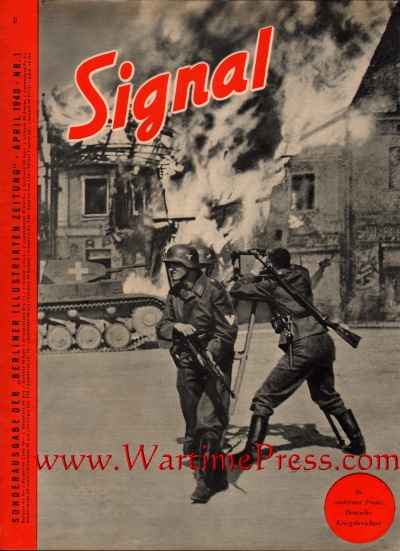
Description
Signal
1. Jahrgang • Folge 1 • Berlin, April 1940, Nr. 1
Sonderausgabe der »Berliner Illustrierten Zeitung« | Special edition of the Berliner Illustrirten Zeitung
Published by Deutscher Verlag, Berlin SW 68. Editor-in-chief: Harald Lechenperg. Bi-weekly.
44 pages scanned.
Overview
Signal was the Wehrmacht’s internationally distributed propaganda magazine, published in up to twenty languages for neutral and occupied countries. This inaugural 1940 issue — produced on the eve of the western campaign — combines military reportage, political-economic analysis, human-interest features, and striking photography, including nine color plates. The tone throughout is confident and propagandistic: Germany is portrayed as economically self-sufficient, militarily superior, and fighting a defensive war against British financial hegemony.
Fallen War Correspondents — “Die Kriegsberichter”
A full-page memorial (p. 4) honors fifteen Signal war correspondents killed in action in Poland, at the Westwall, with the Luftwaffe, and at sea — described as having fallen “in vorbildlicher Pflichterfüllung” (in exemplary fulfillment of duty):
Leutnant OTTO PIEPER • Funker HANS FREYER • Wachtmeister HERMANN LEITZ
Feldwebel ERICH WESTRÖM • Gefreiter GÜNTHER KLEINGÄRTNER • Gefreiter JOSEF EMBACH
Unteroffizier PAUL THIEL • Matrose Dr. WALTER TRÖLLER • Leutnant KURT WEGENER
Wachtmeister WERNER BOLD • Soldat RUDOLF LIEGERT • Funker HANS SCHLÜTER
Gefreiter WILLY GERLACH • Gefreiter KURT NOSTIZ • Unteroffizier ERNST HESSE
Articles and Features
“Je suis paulreynaudé…” — Prime Minister Paul Reynaud
Pages 2–3. Political profile of the new French PM — former finance minister and champion of free capital markets — tracing his contradictions as he now finances the war through the very foreign loans he once condemned; includes a sidebar on the falling pound and proposed polar-route transatlantic air services.
B&W portrait of Reynaud; map of proposed North Atlantic air routes.
22 Jahre nachher — 22 Years Later
Page 5. Aerial reconnaissance photograph over the Champagne showing WWI shell craters and collapsed trench systems still scarring the landscape two decades on.
Full-page B&W aerial photograph.
Warum Spähtrupp? — Why the Patrol?
By correspondents Liska (illustrator) and Kenneweg (special correspondent)
Pages 6–7. Embedded report from the Western Front explaining the tactical difference between the stealthy Spähtrupp (reconnaissance patrol) and the combat Stoßtrupp (assault patrol), illustrated by a regiment that had already completed 180 patrols and won 68 Iron Crosses.
B&W photo of commander with his sixteen patrol leaders; watercolor illustrations; sketch map.
Unternehmen Kulhanek — Operation Kulhanek
I. Der Spähtrupp II. Stoßtrupp Kulhanek
Pages 8–11. First-person account by Leutnant Kulhanek: on day one he crawls 300 meters on his belly into a French-held woodland to map enemy positions undetected; on day two he leads a dawn grenade assault on the blockhouse, takes prisoners, and withdraws without a German casualty.
Full-page B&W wash illustrations; dramatic double-page spread of the assault and French surrender (p. 11).
Frühling im Schnee — Spring in the Snow
Page 12. Brief feature on German frontline soldiers enjoying ski leave in the Tyrolean Alps after the Christmas lifting of the Urlaubssperre (leave ban).
COLOR: sun terrace of the Schneegrubbe above Innsbruck crowded with skiers; COLOR close-up of a couple in ski clothes — the issue’s first color plates.
Vom Kriege — On War
Militärisch-politische Betrachtungen von Oberst *** (Military-Political Observations by Colonel ***)
Pages 13, 42. Long strategic essay arguing that Hitler has broken Germany’s post-Versailles encirclement, unified central-European heavy industry, and left England with no viable path to victory short of a land invasion — supported by production statistics, shipping-loss comparisons, and quotes from Liddell Hart, General Maurice, and General J.F.C. Fuller.
Kriegswirtschaft — so und so — War Economy: This Way and That
Page 15. Contrasts Germany’s unified economic command under Göring with Britain’s fragmented network of coordination committees, arguing that institutional pluralism makes effective British war-economy management impossible.
B&W portraits of Simon, Cross, Burgin, and Hankey alongside a large portrait of Göring.
Die halbe Welt steht Deutschland offen! — Half the World Stands Open to Germany!
Pages 16–17. Economic-geographic feature arguing that Britain’s blockade has failed because Germany trades freely with more than twenty countries, receiving oil, grain, ore, and raw materials by rail from the Soviet Union and Southeast Europe.
B&W photo of freight trains on the Przemysl bridge; COLOR full-page pictorial supply-zone map stretching from England to Japan.
Zwischen den Fronten — Between the Fronts
Berichte aus dem neutralen Ausland / von Alfred Gerigk
Pages 18–20, 36. Thriller-paced two-part account of Dr. Fritz Mannheimer — the German-born Amsterdam banker who secretly financed 415 million gulden in French rearmament loans — his sudden death at his Vaucresson château in August 1939, the collapse of Bankhaus Mendelssohn, and the 40-million-gulden loss ultimately borne by the Dutch economy.
No photographs; COLOR fashion illustration (p. 19) captioned with an ironic dialogue about neutrality and English pressure.
Gebirgsjäger — Mountain Riflemen
Pages 21–23. Photo feature on German mountain troops — their Polish campaign performance in the Carpathians, winter combat tactics, Gebirgsartillerie in the field, and the code of comradeship forged on rock and ice.
COLOR throughout: mule on forest trail; sniper in snow; rock climbers; gun assembly in snow; close-up officer portrait.
Erfüllter Künstlertraum — An Artist’s Dream Fulfilled
Pages 24–26. Profile of Third Reich sculptor Professor Josef Thorak, showing him at work in his Hitler-commissioned Staatsatelier (designed by Speer) on monumental state commissions including a 16-meter Victory Goddess for Nuremberg and a Frederick the Great bronze for the new Reichsbank.
COLOR: Thorak adjusting a life-size nude model alongside a large clay figure (p. 24). B&W: sculptural group; Siegesgöttin model; Staatsatelier exterior; Chiemsee estate interior.
Am laufenden Band … Flugzeug — On the Assembly Line … Aircraft
Pages 28–29. Industrial feature contrasting Germany’s uninterrupted Fließband aircraft mass-production — illustrated by six parallel bomber-fuselage assembly lines — with Britain and France still struggling to convert from peacetime to war manufacturing.
B&W: factory floor; Fieseler Storch in flight; Heinkel He 111 K nose in combat.
Schreibt uns doch ‘mal … — Do Write to Us …
Pages 30–31. Domestic propaganda piece introducing the fictional “Familie Baumann” and a detailed weekly ration infographic to reassure foreign correspondents — and neutral readers — that Germany is not going hungry.
B&W family photographs; full ration-chart infographic across two pages.
Im Passo Romano — In the Roman Step
Page 32. Feature on Mussolini’s Italy — the new parade step, the empire from the Alps to the Red Sea, and the combat record of the Alpini and Bersaglieri in Ethiopia and Albania.
B&W: Rome parade past ancient ruins; Alpini on Ethiopian peaks; Italian tank column; Bersaglieri at the run.
Flak — Anti-Aircraft Artillery
Page 33. Technical feature explaining how sound-locators, searchlights, and gun batteries are linked by automatic electrical transmission so a single operator can engage a target without direct visual contact.
COLOR: night scene of soldiers at an anti-aircraft searchlight with twin blue beams — among the issue’s most striking images. B&W insets: range-finder and observer.
Musterkarte, auf Stein gemalt … — Sample Card, Painted on Stone …
Page 34. Caption feature showing an air-observer who has painted enemy aircraft recognition markings — Polish, French, and British insignia — directly onto his observation post’s stone parapet.
COLOR overhead photograph: soldier walking past vivid red, white, and blue painted roundels on cobblestones.
Schuß auf den Bazillus — Shot at the Bacillus
Page 35. Science feature on the Mikromanipulator — a precision microscope instrument used to isolate a single bacterial cell from hundreds of thousands for vaccine and serum pure-culture work, building on Emil von Behring’s serum-therapy tradition.
B&W microphotographs and lab close-ups.
Fisch ist fesch — Fish is Fashionable
Fischleder — ein neuer Werkstoff
Page 37. Wartime materials feature on Frankfurt’s Modeamt producing blouses, dresses, hats, gloves, and accessories from tanned fish leather — pollock, cod, and redfish skins — as a substitute material.
B&W photographs of cutting table, ironing, and model in full fish-leather outfit.
Beherrscher der Nordsee — Masters of the North Sea
Page 38. Portrait feature celebrating four U-boat aces: Prien (Scapa Flow), Schulze (114,510 tons sunk), Schuhart (sank HMS Courageous), and Hartmann (80,000 tons in two patrols).
B&W portraits of all four commanders; B&W photograph of a U-boat at speed.
Riesen ragen in den Himmel — Giants Rise into the Sky
Page 39. Dramatic full-page photograph of a German heavy railway gun elevated against a cloudy sky, a lone soldier dwarfed at its base.
Full-page B&W photograph.
Schwere Fernkampf-Geschütze — Heavy Long-Range Artillery
Page 40. Photo feature on German railway artillery — a battery of four guns, a Dicke Berta howitzer, a fixed emplacement gun, and ammunition being loaded.
B&W photographs.
Advertisements
p. 2 — ARADO Flugzeugwerke GmbH, Potsdam: Arado Ar 96 B two-seat trainer/light combat aircraft.
p. 27 — RHEINMETALL-BORSIG AG, Berlin-Tegel: industrial steam-power and chemical-plant equipment.
p. 35 — ADLER Automobile, Frankfurt/Main: Trumpf Junior, 2 Ltr., and 2.5 Ltr. models.
Back cover inside — Indanthren dye brand: COLOR bird’s-eye view of spring fabric rolls as a formal garden.
Back cover exterior — COLOR fashion illustration by ‘arwit’: man and woman with sardonic caption about neutrality and persuasion.
Color Plates Summary
• p. 12 — Ski terrace above Innsbruck; couple in ski clothes
• p. 17 — Full-page pictorial economic supply-zone map, Europe to Japan
• p. 19 — Fashion illustration with political caption (decorative)
• pp. 21–23 — Gebirgsjäger series: mule trail, sniper, climbers, gun crew, officer portrait
• p. 24 — Thorak with nude model and clay sculpture in studio
• p. 33 — Anti-aircraft searchlight at night, twin blue beams
• p. 34 — Aircraft-recognition markings in national colors painted on stone
• Back cover inside — Indanthren fabric advertisement
• Back cover exterior — Fashion illustration by ‘arwit’