

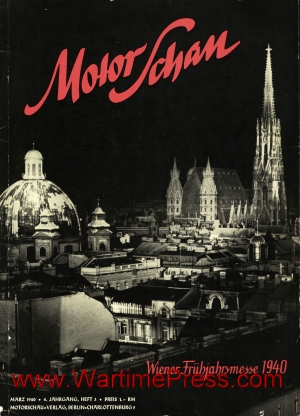
Description
MOTORSCHAU
Wiener Frühjahrsmesse 1940
Issue: Volume 4, Issue 3 — March 1940
Publisher: Motorschau-Verlag, Berlin-Charlottenburg 5
Editor-in-Chief: Reinhold Otte
72 pages scanned
Context: Special issue tied to the Vienna Spring Trade Fair (Wiener Frühjahrsmesse), March 10–17, 1940
Main Editorial Content
Chronik des Krieges (War Chronicle) — pp. 158–168
A day-by-day account (4th installment) covering January 22 through February 23, 1940. Topics include: naval engagements and merchant shipping losses in the North Sea and Atlantic, air reconnaissance operations over Britain and France, the Russo-Finnish War on the Karelian Front, the Altmark incident (British destroyer HMS Cossack’s seizure of the German supply ship Altmark in Norwegian waters), diplomatic incidents, and submarine warfare statistics.
Luftfahrt-Chronik des Auslandes (International Aviation Chronicle) — pp. 170–172
International aviation news covering developments in Belgium (SABENA resuming Congo routes), Cuba (international aerobatic competition in Havana), France (Henry Farman’s new twin-engine design), Great Britain (De Havilland propeller brake patent), Holland (Fokker G2 fighter design; new wind tunnel), Italy (new low-cost autarky sports aircraft), and the USSR (the Gotha Go 150 and the G27 low-wing monoplane).
Beherrscher der Nordsee (Masters of the North Sea) — p. 177
A photographic feature with the caption ‘Then as now!’ showing a German naval aircraft flying low over rough North Sea waters from the deck perspective of a ship.
Deutschland motorisiert Südosteuropa (Germany Motorises Southeast Europe) — pp. 178–183
A detailed analysis of Germany’s growing automotive export dominance in southeastern Europe. Covers Yugoslavia, Hungary, Bulgaria, Romania, and Greece, with statistics on vehicle fleet growth (1935–1938), import figures, road infrastructure challenges, tariff reforms, and market share data. The article frames the Vienna Spring Fair as a showcase of German automotive industrial strength for southeastern export markets.
Die Treibstoffversorgung im Kriege (Wartime Fuel Supply) — pp. 184–187
By Herdin Duden of Pölitz. A strategic and technical article on wartime fuel logistics. Discusses: the distinction between peacetime and wartime fuel demand (qualitative shift toward aviation fuel); global oil and coal distribution; Britain and France’s dependency on overseas supply lines vs. Germany’s domestic coal-to-fuel hydrogenation program (the Four-Year Plan); the vulnerability of Allied tanker routes; and a historical parallel drawn between the Punic Wars (Rome vs. Carthage) and the current conflict. Accompanied by striking industrial photographs of a German synthetic fuel plant.
Das Werk Gottlieb Daimlers (The Work of Gottlieb Daimler) — pp. 188–191
A tribute article by Paul Siebertz marking the 40th anniversary of Gottlieb Daimler’s death (March 6, 1900). Traces Daimler’s career from his time at the Deutz Gasmotorenfabrik with Nikolaus Otto, through the development of the first practical high-speed gasoline engine in Bad Cannstatt (1882–1885), and his contributions to automobile, boat, aircraft, and military motorization. Richly illustrated with period photographs of early Daimler vehicles (1885–1901), including the first Mercedes-branded car (1901).
Keimzelle der Motorisierung (Cradle of Motorisation) — pp. 192–199
A photo-reportage by Paul Hellersberg on Klöckner-Humboldt-Deutz AG (KHD) in Cologne-Deutz — described as now the world’s largest engine manufacturer. Covers the company’s origins with Nikolaus August Otto and Eugen Langen (atmospheric gas engine, 1867; four-stroke engine, 1876), the Deutz Engine Museum, mass production of diesel engines, tractors, diesel locomotives, and the Magirus vehicle plant in Ulm (trucks, fire engines, buses, the NSDAP Reichs-Autozug propaganda vehicle fleet). Text and captions appear in German, English, and French.
Me 109 gegen Vickers Wellington (Me 109 vs. Vickers Wellington) — pp. 200–201
An illustrated tactical article with dramatic artwork by Max Sweekhorst, describing the attack methodology of Messerschmitt Me 109 fighters (powered by the Daimler-Benz DB 601; world speed record: 755 km/h) against formations of British Vickers Wellington III bombers (twin 1,150 hp Star engines; cruising speed 380–400 km/h; 500 kg bomb load). Explains the three-phase attack sequence with diagrams. Full trilingual text in German, English, and French.
Deutsche Luftfahrtsammlung in Berlin (German Aviation Collection in Berlin) — pp. 202–206
By Walter Mackenthun. A report on the recently redesigned German Aviation Museum at Lehrter Bahnhof, Berlin. Describes the historical section (Lilienthal glider, Etrich Taube, Grade triplane, Do X, Richthofen’s red triplane replica, Hitler’s Lufthansa aircraft 1929–35), the modern section (Henschel surface fabrication equipment, Junkers engine development, Blohm & Voss tubular spar wing), the engine hall (60+ water- and air-cooled aero engines), and the NS-Flying Corps room.
Betrieb mit Flüssiggasen (Operation with Liquid Gas) — pp. 207–210
A technical article with pen-and-ink illustrations on the use of liquefied petroleum gases (LPG) as alternative automotive fuel — relevant in the context of wartime fuel rationing.
Der gepanzerte Kristall (The Armoured Crystal) — pp. 213–223
A richly illustrated, literary feature article — part travelogue, part industrial report — on the manufacture of safety glass (Sicherheitsglas) for automobile windscreens. Written in an evocative, almost poetic style, it traces the history of glass from ancient Persia and Rome through medieval stained glass, describes a night drive to the glass factories of the Aachen region (on the Belgian-Dutch-German border), and provides a vivid account of the industrial processes: melting quartz sand, casting, grinding, polishing, and the ‘armouring’ (tempering/laminating) process. The article also discusses the 1938 German law mandating safety glass windscreens. Full-colour photographs throughout.
Brief an einen jungen Flieger (Letter to a Young Aviator) — pp. 224–228
By Curt Rabe (Lieutenant, WWI). An epistolary article addressed to a young WWII pilot, recounting the author’s experiences flying with Jagdstaffel 27 (commanded by then-Oberleutnant Hermann Göring) in Flanders, 1917–1918. Discusses the psychology of waiting, aerial combat, camaraderie, and the differences between WWI and WWII air warfare. Illustrated with rare archival photographs from Rabe’s personal album, including images of Göring at Iseghem aerodrome.
Chronik des Monats (Monthly Chronicle) — pp. 228–230
Industry news: full list of exhibitors at the Vienna Spring Fair (cars, motorcycles, trucks); Auto Union dividend announcement; racing news (Mille Miglia postponed; BMW NSKK team); Steyr-Skoda distribution agreement; Alfred Teves GmbH hydraulics company founded in Berlin; Lufthansa resuming international schedules; Hirth-Motoren new aero engine (HM 515); Junkers Ju 52 records in South America and Scandinavia; Professor Prandtl awarded Goethe Medal.
Key Advertisers
Automotive & Transport
• Mercedes-Benz
• Auto Union (Audi, DKW, Horch, Wanderer)
• Borgward (Bremen) — passenger cars, trucks, electric vehicles
• Adlerwerke (Frankfurt) — automobiles, bicycles, typewriters
• Maybach-Motorenbau GmbH (Friedrichshafen)
• Stoewer-Werke AG (Stettin) — cars, all-terrain vehicles, fire engines
• Gräf & Stift (Vienna)
• A. Fross-Büssing KG (Vienna) — trucks
• Büssing-NAG — heavy trucks
• VOMAG Maschinenfabrik AG (Plauen-Vogtland) — trucks, buses
• Krupp Kraftfahrzeuge (Essen)
• Saurer Werke AG (Vienna)
• Österreichische Automobilfabrik AG (Vienna) — MAN-licensed buses
Aviation
• Arado Flugzeugwerke GmbH (Potsdam) — Ar 96B trainer/light combat aircraft with 360/450 PS Argus AS 410A engine
• Henschel Flugzeugwerke AG (Schönefeld bei Berlin)
• Mauser-Werke AG (Oberndorf) — hunting, sport & defence weapons; precision tools; industrial sewing machines
Engines, Components & Industrial
• Klöckner-Humboldt-Deutz AG (Cologne) — engines & vehicles
• Robert Bosch GmbH (Stuttgart) — spark plugs, magnetos, generators
• NSU Werke AG (Neckarsulm) — motorcycles, mopeds, bicycles
• Mahle KG (Bad Cannstatt) — light-alloy pistons, injection-moulded pistons, filters
• Alfred Teves GmbH (Frankfurt) — ATE cylinder liners (centrifugal casting)
• Karl Schmidt GmbH (Neckarsulm) — pistons
• Aluminiumwerke Nürnberg GmbH — Nüral pistons
• ZF — Zahnradfabrik Friedrichshafen AG — gears & transmissions
• Steyr-Daimler-Puch AG — Steyr roller bearings
• MAN — Maschinenfabrik Augsburg-Nürnberg AG — testing machines
• Fichtel & Sachs AG (Schweinfurt) — Sachs motors
• Westdeutsche Werkzeugmaschinen AG (WEWAG, Düsseldorf) — machine tools
• Matra-Werke GmbH (Frankfurt) — engine overhaul machines
• OIGEE Optische Anstalt (Berlin-Schöneberg) — reflex sights & optical instruments
Other Notable Advertisers
• Ernst Leitz Wetzlar — Leica cameras
• OSRAM — automotive bulbs
• BERU-Werk A. Ruprecht (Ludwigsburg) — spark plugs & glow plugs
• Gargoyle Schmiermittel — Deutsche Vacuum Oel AG (Hamburg) — lubricants
• Knecht KG (Stuttgart-Bad Cannstatt) — oil filters
• Kronprinz AG (Solingen-Ohligs) — wheels
• Nordland — snow chains, safety glass, wiper blades
• FAMO Fahrzeug- und Motorenwerke GmbH (Breslau) — diesel tractors & crawlers