

Description
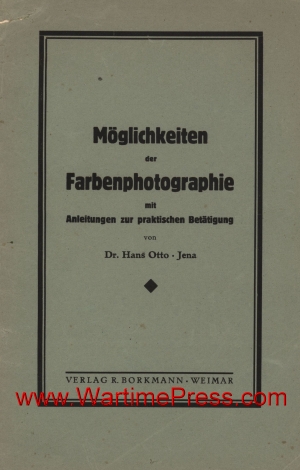
This is a 1929 German booklet scanned in PDF format titled “Möglichkeiten der Farbenphotographie mit Anleitungen zur praktischen Betätigung” (Possibilities of Color Photography, with Instructions for Practical Use) by Dr. Hans Otto of Jena, published by Verlag R. Borkmann, Weimar.
44 pages scanned. Instant PDF download.
It’s a practical guide aimed at amateur photographers who want to try color photography without wading through the more exhaustive specialist literature of the time (the author names Hübl, König, Mebes, and Miethe as the “heavy” references he’s condensing). The booklet covers:
Theory and history: direct vs. indirect color processes, the Lippmann interference method, bleach-out processes, the Young-Helmholtz theory of color vision, and additive vs. subtractive color synthesis
Early three-color methods: Maxwell’s pioneering 1861 experiments, three-filter cameras, Uvachromie, and Pinatypie
Screen-plate (“Raster”) color photography: the star attraction, focusing on the Autochrome plate (Lumière) and the Agfa color plate — the two amateur-friendly options praised for their relative simplicity
Practical shooting guidance: filters, exposure times, artificial light sources (Nitralicht, flash), and common pitfalls like color casts from reflected light
Darkroom processing: development, the reversal (Umkehrung) process, intensification, and reduction techniques
The book includes two tipped-in color plate reproductions (an Agfa color plate photo of a girl with flowers, and a Lumière Autochrome cityscape) and closes with period advertisements for Zeiss lenses, Justophot light meters, and Agfa color plates.
It’s a nice piece of photographic history — a snapshot of amateur color photography right before Kodachrome-era film technologies would make screen-plate processes obsolete.