

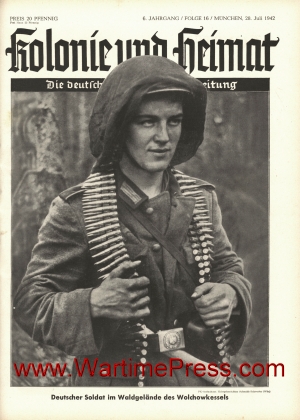
Description
Kolonie und Heimat
Dienstag, 28. Juli 1942 • 6. Jahrgang • Folge 16
Reichskolonialbund e.V., Berlin — Verlag des Reichskolonialbundes, München 2, Brienner Straße 10
12 pages scanned. Instant PDF download.
Preis 20 Pfennig (Frei Haus 22 Pfennig)
Cover Page
Caption: „Deutscher Soldat im Waldgelände des Wolchowkessels“ (“German soldier in the wooded terrain of the Volkhov pocket”)
Subject: Portrait of a young German infantryman wearing a camouflage hood/rain cape, draped with ammunition belts, holding a stick-handled grenade.
Location: Wolchowkessel (Volkhov pocket), Eastern Front.
Photo credit: Kriegsberichter Schmidt-Scheeder (PK-Aufnahme, Wb.).
Major Headlines & Content
Ägypten (Egypt) — „Die Nahtstelle des Empire“: article on Egypt as the vulnerable seam of the British Empire, covering its history as a nominally independent British colony, the Wafd-Partei’s independence movement, forced labour on Nile irrigation works, new British-built strategic roads and the Suez Canal, and Rommel’s advance to the gates of Alexandria. Named: Zaghlul Pascha, Generalfeldmarschall Rommel, Churchill. Places: Ägypten, Nildelta, Suezkanal, Duala, Khartum, Alexandria, Abessinien, Syrien, Palästina, Iran, Irak. Author: Dr. W. Sidebar „Die ruhmreiche Tradition deutschen Kampfes in Afrika“ reproduces a telegram exchange between General Ritter von Epp and Generalfeldmarschall Rommel congratulating him on the capture of Tobruk and his promotion.
Gesperrt! Die Achsenflotte blockiert das Mittelmeer (Blocked! The Axis Fleet Blockades the Mediterranean) — Report on the German and Italian navies, with Luftwaffe support, closing the Mediterranean to British shipping and troop transport after the fall of Malta and Kreta, forcing Allied supply convoys for the Soviets to reroute via Murmansk or the Persian Gulf. Includes note that Duce Benito Mussolini personally decorated crews for sinking 7 warships and 111,000 BRT of merchant shipping. Named: Benito Mussolini. Places: Mittelmeer, Gibraltar, Alexandrien, Kreta, Malta. Photo credits: PK-Kriegsberichter Pietsch, Kratochwil, Geiseler, Atl.-Luce.
Heiligtum mit weißem Kreuz (Sanctuary with a White Cross) — Feature on the water-supply organisation sustaining German and Italian troops in the North African desert war, describing water trucks, filtration, and the white-cross-marked drinking-water canisters distinguished from petrol canisters. Places: Nordafrika, Cyrenaika, Marmarica. Text: Kriegsberichter Hanns Groß; photo credits: Groß, Ellerbock.
Wüstenkampf in Südwest (Desert Combat in South-West Africa) — „Deutsches Soldatentum in Afrika“: historical account of the 1904–1905 colonial war in Deutsch-Südwestafrika, centred on the three-day battle for the water point at Großnabas against a fivefold-superior Hereros/Hottentotten force, and the earlier founding of the Südwester Schutztruppe. Named: Hauptmann von François, Major Leutwein, Truppenführer Lettow-Vorbeck, Reichskanzler Fürst Bismarck, Generalfeldmarschall Rommel (comparison). Places: Großnabas, Windhuk, Deutsch-Südwestafrika. Text: Erich Student; photos: RKB-Bildstelle.
Britische Kuckuckseier in fremden Nestern (British Cuckoo’s Eggs in Foreign Nests) — Illustrated survey, with a numbered map, of scattered British colonial and strategic possessions along the African coasts and sea routes — Gibraltar, Malta, the Suez Canal, Perim, Aden, Sokotra, Sansibar, the Goldküste forts, Kapkolonie, Walfischbucht, and the enclave of Bathurst on the Gambia — framed as Britain nesting its “cuckoo’s eggs” in other nations’ territory. Places: Helgoland, Normannische Inseln, Gibraltar, Malta, Suezkanal, Ägypten, Perim, Aden, Sokotra, Sansibar, Goldküste (Akkra, Secondi, Axim), Kapkolonie, Transvaal, Walfischbucht, Bathurst/Gambia, Kapstadt. Author: K.Sch.
Other Content
Fiction serial — „Liebe auf Elefantenpfaden“ by Josef Viera (2. Fortsetzung; continues on next page). Continuation of the light novel set among coffee planters in Deutsch-Ostafrika, following Hensing, Gottewinter, Eva Lachner and the servant boy Marele on the mountain. Illustration: Schuberth-Goebel.
Nature feature — „Vater Känguruh träumt …“ — short piece on the life and habits of the red kangaroo in Australia. Photo credit: Atlantic.
Reader-response feature — „Regenmäntel, die auf Bäumen wachsen“ — following reader interest in a previous issue’s picture of banana-leaf rain capes, describes bark-cloth rain cloaks used by indigenous people at the Orinoco, as observed by Alexander von Humboldt. Places: Orinoco, Esmeralda.
Anecdote — „Die Anstandsfrist“ — brief historical anecdote about Ludwig XIV threatening Amsterdam in 1672.
Cartoon — „Im Museum für „Meereskunde““ — single gag cartoon of a whale and ship model in a museum display.
Feature — „Als Tierarzt in Afrika“ — anecdotes told by Dr. vet. Aufschneider on 1 April 1900 about treating exotic animal ailments (giraffes, lions, crocodiles, elephants) in Africa.
Trivia spread — „Es irrt der Mensch — !“ — four short illustrated trivia questions correcting common misconceptions (Hans Sachs and the lilac, an error on a postage stamp, Wilhelm Tell’s apple shot, and tobacco in Goethe’s Faust).
Puzzles — „Raten und Denken“ — a Kryptogramm, a Rösselsprung (knight’s-move puzzle), and a Verschieberätsel. Solutions to the previous issue’s (Folge 15) Silbenrätsel are also printed.
Photo feature — „Großwild der Meere“ — on big-game sea fishing for swordfish, tuna, and shark, including spear-fishing in the shark-infested Coral Sea. Photo credit: Mauritius.
Advertisements — Vauen, Dr. Oetker Einmache-Hülfe, Ohropax, Briefmarken-Handlung Walter Behrens, Fernunterrichts-Gesellschaft, Alex Kamp Kamp-Konzentrate, Adox Foto, Tabakex, Gütermanns Nähseide, Nestlé, Austria (Zigarren, Zigaretten, Rauchtabake), Sepso.