

Description
Kolonie und Heimat – Number 3, 28 January 1941
Scanned pages: 24 | Instant PDF download
Historical German colonial illustrated magazine (“Die deutsche koloniale Bilderzeitung”), published by the Reichskolonialbund, digitized.
Cover
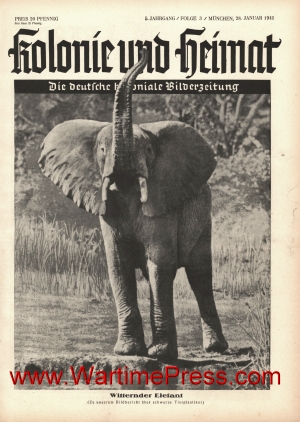
A photograph of an elephant raising its trunk to scent the air, captioned “Witternder Elefant” (“Scenting Elephant”), tied to the inside photo report on Black African animal sculptors. No war correspondent credited on the cover.
Main Articles
“Bardia”
Argues that British propaganda inflated the capture of the small Libyan port of Bardia into a major “victory” to offset a string of setbacks, and predicts it will only be a further step toward Britain’s ultimate defeat.
No author credited; photo credit: Aufn. Stowasser.
“Nauru, die Phosphatinsel in der Südsee”
Describes Nauru’s economic importance as a phosphate-rich Pacific island, its bombardment by a German auxiliary cruiser, and German shipping raids in the region (continued on page 65).
No author credited; photo credits: Aufn. Rose, Archiv.
“Bulgarische Bilder”
A photo essay on rural Bulgarian life, including a German war memorial (“Totenburg”) at Bitolj built by German soldiers in 1916, and scenes of villages, markets, and a Swabian settler farmer.
No author credited; photo credit: Aufn. Photodienst Holzapfel.
“Aus Afrikas Kinderstube”
A photo essay on African childhood and child-rearing practices, including traditional skin treatments and children’s daily life.
No author credited; photo credits: Aufn. Duncker-Verlag, Archiv.
“Makao”
Describes the Portuguese colony of Macau, its history, gambling culture (Fan-Tan), and mixed Chinese-Portuguese character, plus wartime refugee pressures from Hong Kong.
No author credited; photo credit: Aufn. Dr. Herrlich.
“Was weißt Du von Afrika?”
An educational overview of Africa’s geology, climate, river systems, and plant life (continued on page 65).
No author or war correspondent credited.
“Wir sind doch keine Hasenfüße!” (Käthe Palm)
A true-life story of two German boys, sons of settler families on the upper Amazon in Brazil, and a boy’s rescue of his friend from a crocodile attack.
Author: Käthe Palm; illustration by Moritz Pathé.
“In Peters Blockhaus” (Roman von Maria Melchers, 5. Fortsetzung)
Serialized novel installment continuing the story of Magnus, Hofbauer, and the Hennemann/Büttner families as Magnus prepares to depart for Africa.
Author: Maria Melchers (novelist). No war correspondent or photo credit (illustrated fiction).
“Die Perle Allahs”
A short item on the world’s largest pearl (14 pounds), its history with a Muslim sultan, and its later use in a Bayer malaria-medicine promotional anecdote.
No author credited.
“…und so sieht sie der Schwarze”
Continuation of the cover’s photo report, showing African wildlife alongside wood, horn, and ivory sculptures of the same animals made by Black African artists/craftsmen.
No individual sculptor or author named; no photo credit line given on these pages.
“Bei den deutschen Zinnschürfern von Karagwe”
An account of a visit to small-scale German-run tin mines at Karagwe on the German East Africa–Uganda–Congo border, describing extraction methods and living conditions, including past lion attacks on workers.
No author credited; photo credit: Aufn. Dr. Griesheim.
“Mexikanische Kampfhähne”
Describes Mexican cockfighting culture: breeding, staging fights, spectators, and betting.
No author credited; photo credits: Aufn. Photodienst Holzapfel, Duncker-Verlag.
“Beim schwarzen Friseur”
A photo essay on elaborate traditional African hairstyles across different peoples (Basuto, Wambulu, Ababua, Massai, Wagatti, Mangbetu).
No author credited; photo credit: Aufn. Archiv.
“Südwester Schlangengeschichte” (Fritz Spiesser)
A tall-tale-style humorous snake story set among settlers in German Southwest Africa, in the tradition of exaggerated bushveld yarns.
Author: Fritz Spiesser.
“Skilauf – wie noch nie!”
A page of satirical political cartoons depicting Britain (and Churchill) struggling on a metaphorical ski slope of wartime setbacks.
Illustrator credited: gezeichnet von Walter Fuchs (“drawn by Walter Fuchs”).
Artists Mentioned
- Moritz Pathé – illustration accompanying “Wir sind doch keine Hasenfüße!”
- Walter Fuchs – illustrator of the cartoon page “Skilauf – wie noch nie!”
War Correspondents (Kriegsberichter) Named
None explicitly credited as Kriegsberichter in this issue. Photo credits are attributed to photographers and agencies (Scherl, Stowasser, Rose, Photodienst Holzapfel, Duncker-Verlag, Dr. Herrlich, Dr. Griesheim, Archiv) rather than designated war correspondents.