

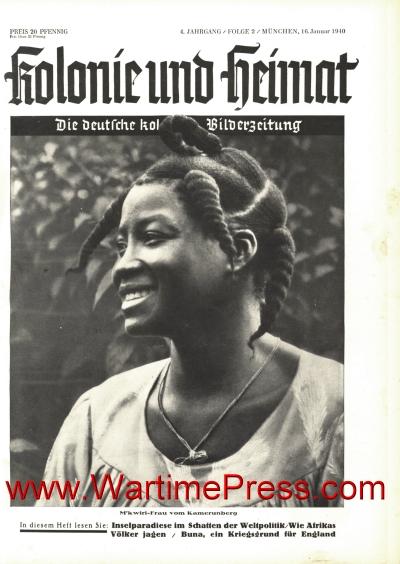
Description
Kolonie und Heimat
Die deutsche koloniale Bilderzeitung
Dienstag, 16. Januar 1940 • 4. Jahrgang • Folge 2
Reichskolonialbund e.V., Berlin • Verlag des Reichskolonialbundes, München 2 NW
20 pages scanned
Cover Page
Caption: „M’kwiri-Frau vom Kamerunberg“ (“M’kwiri woman from Mount Cameroon”)
Subject: Portrait photograph of a young African woman with an elaborate braided and coiled hairstyle and a beaded necklace, smiling, photographed outdoors against foliage.
Location: Kamerunberg (Mount Cameroon), Cameroon.
Photo credit: F. O. Waydyk, München (cover design by W. Fuchs, München).
Cover teaser: „Inselparadiese im Schatten der Weltpolitik / Wie Afrikas Völker jagen / Buna, ein Kriegsgrund für England“.
Major Headlines & Content
Inselparadiese im Schatten der Weltpolitik (Island Paradise in the Shadow of World Politics) — Feature on the Dutch East Indies, illustrated with a map of Southeast Asia and photographs of a Bali market and a sailing prau. Argues that British possessions form a strategic “ring” around the Dutch colonies, leaving Dutch policy dependent on British goodwill. Continues on a later page. Place names: Niederländisch-Indien, Bali, Sumatra, Java, Singapur, China, Hongkong, Formosa, Philippinen, Borneo, Celebes, Timor, Neu-Guinea. Text and photos: G. Pommeranz-Liedtke.
Raubstaat England (England, the Robber State) — Polemical feature listing British territorial acquisitions from 1583 to 1920 (Neufundland, Gibraltar, Helgoland, Singapur, Ägypten, Zypern, Nigeria, Transvaal, and others), illustrated with a caricature sack showing Britain’s share of world trade in raw materials (Jute, Nickel, Gold, Kautschuk, Wolle, etc.). Drawn from a Munich exhibition titled „Raubstaat England“. Photo credit: Huhle.
Wie Afrikas Völker jagen (How Africa’s Peoples Hunt) — Illustrated feature on traditional hunting methods: elephant hunters in the Ahaggar steppes, Massai lion hunters in East Africa, Sudanese horsemen hunting ostrich, Nandi tribesmen fighting a buffalo, gorilla hunters on the Loango coast (West Africa), Hottentot rhinoceros hunters, and hippopotamus hunters in the Congo papyrus swamps. Text: Dr. R. Dammert. Illustrations: Kurt Kiesslich.
Other Content
Feature — Britische „Kolonisation“ — Contrasts British neglect of Indian agriculture (cow-dung used as fuel, primitive wooden ploughs, rural poverty) with claims of superior German colonial administration; photographs of Indian villagers and dung-cake storage. Photo credit: Schröder (2).
Travel feature — „Daheim“ in Kamerun (“At Home” in Cameroon) — First-person account of German colonial life in Cameroon: a plantation at Tombel, banana cultivation near Buea and Duala, German settler hospitality, and a German doctor’s rounds. Locations: Tombel, Buea, Duala, Bibundi coast. Text and photos: Hans Gerd Esser.
Feature — „Buna“, ein Kriegsgrund für die Engländer (“Buna,” a War Pretext for the English) — Argues that German synthetic rubber (Buna) threatens British rubber-plantation interests in India and Ceylon, and accuses Britain of having stolen rubber-tree seed stock and dye patents from Germany. Illustrated with photographs of rubber tapping and processing in Ceylon and India. Text and photos: Dr. P. Kuhnen.
Historical series — Weltgeschichte um das deutsche Meer (World History around the German Sea), Part 1 — Survey of three centuries of German Hanseatic and colonial activity in the Baltic and North Sea, covering Lübeck as “Queen of the Hanse,” Bremen, Hamburg, and the island of Wisby (Gotland). Place names: Lübeck, Bremen, Hamburg, Riga, Wisby/Gotland, Nowgorod, Bergen, London. Continues in a later issue („Fortsetzung folgt“). By G. Pommeranz-Liedtke.
Book column — Das aktuelle politische Buch — Short reviews of two anti-British political pamphlets: „Die englischen Kriegsbeber“ by Otto Kriegk and „Auf den Spuren des Secret Service“ by Erwin Barth von Wehrenalp (both Nibelungen-Verlag), discussing British wartime propaganda and intelligence figures including Winston Churchill and Duff Cooper. By Dresler.
Photo feature — Ein Kannibale wird rasiert (A Cannibal Gets Shaved) — Photo report on the Big Mambas and Middle Mambas peoples of Malekula Island, New Hebrides; depicts a tribal chief and a recruited labourer being groomed and shaved aboard a recruitment ship for the first time. Named individuals: chief Ringapaet of Tomaru; village of Tinambit. Photo report by E. Witzleben-Hoppe.
Photo feature — Die „schwarzen Diamanten“ von Deutsch-Südwest (The “Black Diamonds” of German South-West Africa) — Report on karakul (Persian lamb) pelt farming in Deutsch-Südwestafrika, covering pelt grading, lamb processing, and farm life. Photo report by Mauritius-Henrici.
Advertisements — Henko-Bleichsoda, Fichte-Verlag („Unser Kamerun von Heute“), Trinerval-Ovaltabletten, Herbin-Stodin, Efasit, Heumanns Herz-Hilfe, St.-Martin-Drageen, Tornedo-Freilauf (Fichtel & Sachs), Gutenberg-Versand Dresden, Sambo (Reichskolonialbund youth monthly).