

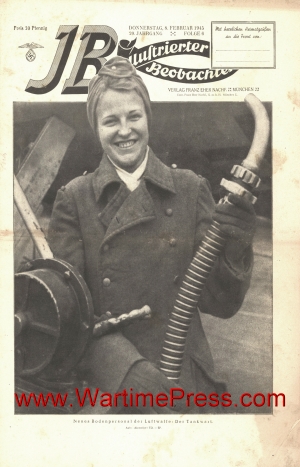
Description
Illustrierter Beobachter
Donnerstag, 8. Februar 1945 • 20. Jahrgang • Folge 6
Zentralverlag der NSDAP, Franz Eher Nachf. GmbH, München 22
12 pages scanned. Instant PDF download.
Cover Page
Caption: “Neues Bodenpersonal der Luftwaffe: Der Tankwart.” (“New ground personnel of the Luftwaffe: the refueller.”)
Subject: A smiling young woman in Luftwaffe ground-crew uniform holds a fuel-hose nozzle, illustrating women taking on aircraft refuelling duties.
Location: Not stated.
Photo credit: Ahrweiler / TO. — EP.
Major Headlines & Content
„Melder, schwimmen Sie zum Stützpunkt Berta!” (“Runner, swim to strongpoint Berta!”) — Photo feature on the muddy, waterlogged conditions in an Eastern Front trench position, showing soldiers wading through flooded trenches, bailing water, and drying clothing in a bunker. Photo credit: PK-Kriegsberichter Blaschka (Atl.).
Ursula ist auch dabei (“Ursula is there too”) — Photo feature on women serving as helpers for the Organisation Todt (OT): laundry and linen work in a recovery home, a Red Cross nurse serving food to front workers, an OT equipment-issue point, and a laboratory assistant at a microscope in an OT field hospital in Norwegen.
Wer die Petacona singen hört… (“He who hears the Petacona sing…”) — Fiction/travel piece by Werner Hopp set on the west coast of Kolumbien, near Buenaventura and the Rio Micay. Describes a priest-adventurer narrator, the American character Tom Hopkins (representative of the “Cultural Corporation Levinthal & Co., New York”), and the legend of the giant snake “Petacona” tied to Don Augusto’s household.
Das strahlende Element (“The radiant element”) — Science article by Dr. Kurt Schmidt, framed as a dialogue between two neighbours (a chemist and a Prokurist) about radioactivity, radium, and its discovery by Pierre and Marie Curie (née Sklodowska) and Henri Becquerel; touches on emanation, half-life, uranium, pitchblende (from Joachimsthal in Bohemia), and the age of the Earth.
Orchideenwunder im tropischen Südamerika (“Orchid wonders of tropical South America”) — Science/nature article by Werner Hopp on orchid diversity across Südamerika, with particular focus on Kolumbien as an orchid-rich country bordering Venezuela, Ecuador, Peru and Brazil; discusses epiphytic, terrestrial and saprophytic orchid types and their pollinators (insects, hummingbirds).
Lebendige Fliegenfallen (“Living flytraps”) — Science article by Hansjoachim Mitsch on carnivorous plants, opening with an anecdote of Dr. Roth of Hansestadt discovering a sundew (Sonnentau) in 1779, then covering Venus flytraps (discovered by John Ellis, 1869, North Carolina), pitcher plants (Nepenthes, Sarracenia), and Charles Darwin’s 1875 book on insectivorous plants.
Freude auf Posten 79 (“Joy at post 79”) — Short fiction piece by Otto Kreutzfeldt about an elderly railway-crossing keeper couple awaiting their soldier son’s train to pass; the son, a Leutnant, jumps off briefly to embrace his parents before the train continues. Not translated — summarised only.
Other Content
Cartoon spread — „Ihr habt recht! Er fährt rückwärts!” — Comic strip by Emerich Huber continuing the “Klamottenexpreß” gag about a mistakenly reverse-driving contraption drawn with a mismatched gear, prompted by readers’ letters pointing out the earlier error.
Puzzles — Kreuzworträtsel (crossword), Silbenrätsel (syllable puzzle), Magisches Quadrat (magic square), Kryptogramm, and a chess problem (Schach-Beobachter, by Major K. Sohnemann). Solutions to the previous issue’s puzzles are also printed.
Advertisements — Deutsche Reichspost, Markenhaus Alfred Kurth, Göbels Backvanina, Zinsser Heilkräuter-Tee, Dr. Boether-Tabletten, Medopharm, Siemens, Vogeley, Chinosol.
Additional Folge 3 Content (bound into this scan)
20 Minuten Panzerfahrer (“20 minutes as a tank driver”) — Reichsminister Albert Speer personally test-drives a Königstiger tank at a troop training ground during an inspection of its steering system, demonstrating its manoeuvrability. Photo credit: Willi Ruge.
Zu Gast bei Graf (“Guest of Graf”) — Oberstleutnant Graf, top-scoring fighter pilot (Brillantenträger, Kommodore), receives a young 18-year-old Gefreite from Gladbach at the front and presents him with his regiment’s new Sturmgewehr. Accompanying article on the AJ (Arbeitseinsatz-Ingenieur), an armaments-ministry role coordinating factory labour efficiency, illustrated report by Elfriede Schrader. Photo credit: PK-Kriegsberichter Blaschka (TO).
Junggesellinnen — gut aufgehoben (“Bachelorettes — well looked after”) — Report on a Hitler-Jugend youth residence (Jugendwohnheim) for working single women named Ulla, Renate and Ingrid, covering sewing lessons, laundry, drawing work in the armaments industry, and communal reading and radio-listening. Photo credit: Transocean — Europapress.