

Description
Illustrierter Beobachter
Sonderheft · April 1938
Zentralverlag der NSDAP, Franz Eher Nachf. GmbH, München 22
40 pages scanned. Instant PDF download.
Special edition: “Der Führer macht Geschichte — Das blitzschnelle deutsche Luftschwert” (“The Führer Makes History — The Lightning-Fast German Air Sword”), compiled with the participation of units that took part in the entry into Austria; edited by Albert Kropp-Partenkirchen.
Cover Page
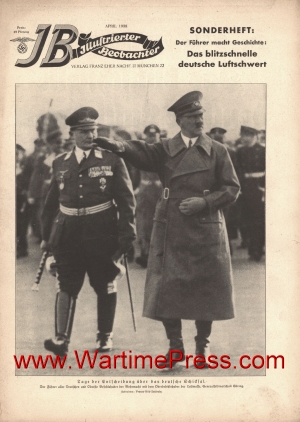
Caption: “Tage der Entscheidung über das deutsche Schicksal. Der Führer aller Deutschen und Oberste Befehlshaber der Wehrmacht mit dem Oberbefehlshaber der Luftwaffe, Generalfeldmarschall Göring.” (“Days of decision over Germany’s fate. The Führer of all Germans and Supreme Commander of the Wehrmacht with the Commander-in-Chief of the Luftwaffe, Generalfeldmarschall Göring.”)
Subject: Adolf Hitler (Führer and Supreme Commander of the Wehrmacht) walking alongside Hermann Göring (Generalfeldmarschall, Commander-in-Chief of the Luftwaffe), saluting reviewed troops.
Location: Not stated.
Photo credit: Presse-Bild-Zentrale.
Major Headlines & Content
Das Vorspiel: Ein Verrat (The Prelude: A Betrayal) — Chronicle of 12 February – 11 March 1938: Schuschnigg’s capitulation to Hitler at Berchtesgaden, the appointment of Seyß-Inquart, and the mounting political crisis leading to the Anschluss. Named individuals: Kurt Schuschnigg (Austrian Chancellor), Dr. Arthur Seyß-Inquart (Federal Minister of the Interior). Location: Wien, Berchtesgaden, Kärnten. Photo credit: Presse-Photo.
Die deutsche Antwort (The German Response) — Diary excerpt of Dr. Richard Eder describing tense, rumour-filled hours in Vienna on 11 March as German intervention approaches. Named individuals: General der Flieger Hugo Sperrle (Commanding General, Luftwaffengruppe 3 Süd); Oberst Bertling (Commandant, Flying Schools of Fliegergruppe 3); Oberst im Generalstab Ritter von Pohl; Major Koller; Major von Trützschler. Location: Wien. Photo credits: F. F. Bauer, Archiv.
Samstag, 12. März — Die deutschen Truppen marschieren in Oesterreich ein (Saturday, 12 March — German Troops March into Austria) — The Wehrmacht crosses into Austria; Hitler’s triumphal drive culminates in Linz. Includes a diary extract of Dr. Ebler, staff physician at the Fliegerhorst Wiener-Neustadt. Named individuals: Generalmajor Wolff (Kommandeur aller Luftwaffenteile in Österreich), Oberstleutnant Korten (Chef des Stabes). Locations: Linz, Wien, Wiener-Neustadt.
Sonntag, 13. März — Das Gesetz über die Wiedervereinigung Oesterreichs mit dem Deutschen Reich wird Reichsgesetz (Sunday, 13 March — The Law on the Reunification of Austria with the German Reich Becomes Reich Law) — Diary of Leutnant Neuf recounting the flight route from Passau to Waizenkirchen and the jubilant welcome from the Austrian population along the way. Locations: Passau, Waizenkirchen, Linz.
Montag, 14. März — Von Linz über St. Pölten kommend, trifft der Führer in Wien ein (Monday, 14 March — Coming from Linz via St. Pölten, the Führer Arrives in Vienna) — Hitler’s arrival in Vienna before ecstatic crowds; further diary extracts from Leutnant Neuf on the march to the capital. Named individuals: Adolf Hitler, Generalmajor Wolff. Locations: Linz, St. Pölten, Wien.
Dienstag, 15. März — “Ein Volk — Ein Führer!” (Tuesday, 15 March — “One People — One Führer!”) — Parade of the Wehrmacht, Luftwaffe, police and SS before Hitler in Vienna; full text of Reichsminister Göring’s order of the day to Luftwaffe soldiers. Named individuals: Adolf Hitler, Generalfeldmarschall Hermann Göring. Location: Wien.
Mittwoch, 16. März — Adolf Hitler, der Führer aller Deutschen, trifft in der Reichshauptstadt ein (Wednesday, 16 March — Adolf Hitler, Führer of All Germans, Arrives in the Reich Capital) — Hour-by-hour account of Hitler’s triumphal return to Berlin amid vast crowds. Location: Berlin.
Donnerstag, 17. März — Generalfeldmarschall Göring kündigt an, dass der Vierjahresplan auch auf Oesterreich ausgedehnt wird (Thursday, 17 March — Göring Announces the Four-Year Plan Extended to Austria) — Telegram from Göring to Reichsstatthalter Seyß-Inquart; ceremonial incorporation of the Austrian General Staff into the German General Staff. Named individuals: Hermann Göring, Dr. Arthur Seyß-Inquart, General der Artillerie Beck, Generalleutnant Kuoff. Locations: Wien, Berlin.
Dienstag, 22. März — Reichspropagandaminister Dr. Goebbels eröffnet mit einer Großkundgebung im Berliner Sportpalast den Wahlkampf (Tuesday, 22 March — Reich Propaganda Minister Dr. Goebbels Opens the Election Campaign with a Mass Rally at the Berlin Sportpalast) — Report on relief distributed to needy families near Wels; a lengthy historical justification of the Anschluss directed against Habsburg legitimism. Named individuals: Dr. Joseph Goebbels, Generalmajor Löhr. Locations: Berlin, Wels.
Mittwoch, 23. März — Das Winterhilfswerk ergreift umfangreiche Sofort-Maßnahmen zur Linderung der Not in Oesterreich (Wednesday, 23 March — The Winter Relief Fund Takes Wide-Ranging Immediate Measures to Ease Hardship in Austria) — Order of the day from the Commander-in-Chief of the 8th Army marking the army’s return to garrison. Named individual: Generaloberst von Bock (Oberbefehlshaber der 8. Armee).
Donnerstag, 24. März — Zum ersten Male seit fünf Jahren marschieren die Wiener SA zu einem Generalappell auf (Thursday, 24 March — For the First Time in Five Years, the Vienna SA March for a General Muster) — Published schedule for Göring’s reception tour of Austria, including stops at Wels, Alpern, Graz and Klagenfurt. Named individual: Hermann Göring.
Samstag, 26. März — Nach einer Besprechung mit seinen Mitarbeitern ordnet der Beauftragte für den Vierjahresplan, Hermann Göring, sofortige wirtschaftliche Maßnahmen zum Aufbau Oesterreichs an (Saturday, 26 March — After Meeting with His Staff, Four-Year Plan Commissioner Hermann Göring Orders Immediate Economic Measures for the Reconstruction of Austria) — Detailed economic programme announced in the Floridsdorf workers’ district: elimination of unemployment, currency conversion, tax relief, road and Autobahn construction, and agricultural and industrial development. Named individual: Hermann Göring. Locations: Floridsdorf, Linz, Tulln, Wien, Salzburg, Graz.
Montag, 28. März — Nach den begeisterten Kundgebungen in Wien trifft Generalfeldmarschall Göring zum Besuch der Stätten der Arbeit in Wiener-Neustadt ein (Monday, 28 March — After Enthusiastic Rallies in Vienna, Göring Arrives in Wiener-Neustadt to Visit Sites of Labour) — First regimental flag presented to an Austrian fighter group; aerobatic display staged for Göring. Named individuals: Hermann Göring, Generalmajor Wolff, Generalmajor Bodenschatz, Dr. Arthur Seyß-Inquart. Location: Wiener-Neustadt.
Mittwoch, 30. März — Gen.-Major Löhr, bisher Chef der österreichischen Luftstreitkräfte, zum Gen.-Lt. und Kommandierenden General der Luftwaffe in Oesterreich ernannt (Wednesday, 30 March — Generalmajor Löhr, Formerly Chief of the Austrian Air Force, Appointed Commanding General of the Luftwaffe in Austria) — Formal transfer of command from Generalmajor Wolff to Generalleutnant Löhr; establishment of a Luftgau- und Ersatzkommando in Vienna. Named individuals: Generalmajor Wolff, Generalleutnant Löhr, Oberstleutnant Korten, Generalmajor Hirschauer. Location: Wien.
Donnerstag, 31. März — Die ehemalige deutsche Reichsstadt Frankfurt erlebt durch den Besuch des Führers ihre höchste Feierstunde (Thursday, 31 March — The Former Imperial City of Frankfurt Experiences Its Finest Hour Through the Führer’s Visit) — Closing order of the day from the Commander of all Luftwaffe units in Austria as the operation concludes and units return to their home garrisons. Location: Frankfurt, Wien.
Other Content
Eyewitness accounts — Diary and report excerpts from Dr. Richard Eder, Dr. Ebers, Kriegsgerichtsrat Steimmer, Leutnant Neuf, and Hauptmann/Regimentsadjutant Bertram, describing the atmosphere in Vienna and Klagenfurt during the Anschluss.
Photo feature — Extensive photo spreads throughout depicting Luftwaffe staff, aircraft (Ju 52, He 46, Ju 86, Do 17, Hs 123), and crowds celebrating in Vienna, Berlin and Mannheim. Photo credits: Hans Schaller, Heinrich Hoffmann, Helmuth Kurth, Zvarcek, Albert Krönner, Nationaler Bilderdienst, Presse-Bild-Zentrale, Weltbild, B. Fischer, Foto Franck.