

Description
Illustrierter Beobachter
Sondernummer • „Frankreichs Schuld“ • no Jahrgang/Folge given
Zentralverlag der NSDAP, Franz Eher Nachf. GmbH, München 22
52 pages scanned
Special thematic issue, undated; cover price 50 Reichspfennig. Includes two supplementary atlas maps not part of the magazine’s own pagination. Internal references (Paul Reynaud’s premiership, the Sumner Welles mission) place publication around March–April 1940.
Cover Page
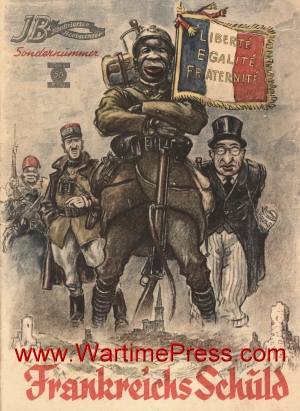
Caption: None; the cover bears the printed title „Frankreichs Schuld“ (“France’s Guilt”) in red lettering rather than a photo caption.
Subject: A painted illustration of a Black French colonial soldier in uniform carrying a rifle and a banner reading „LIBERTÉ EGALITÉ FRATERNITÉ,“ flanked by a French officer and a caricatured civilian figure carrying a press tag marked „HAVAS,“ the latter drawn with antisemitic caricature features. Ruined buildings appear in the background.
Major Headlines & Content
Der Feind deutscher Einheit (The Enemy of German Unity) — Historical survey from Cardinal Richelieu to the French Revolution presenting France as the historic enemy of German unification. Named figures: Kardinal Richelieu, König Ludwig XIV, Marquise von Pompadour, General Melac, Prinz Eugen, Friedrich der Große. Places: Elsaß, Lothringen, Straßburg, Pfalz, Heidelberg, Mannheim, Worms, Speyer, Roßbach, Münster.
Frankreichs Drang nach Osten (France’s Push to the East) — Six maps trace French territorial expansion toward Germany from 925 to 1919, framed as recurring French expansionism. Places shown: Paris, Metz, Toul, Verdun, Straßburg, Elsaß, Lothringen, Savoyen, Nizza, Roussillon.
Vasallenstaat Deutschland (Vassal State Germany) — Describes Napoleon Bonaparte’s domination of Germany, including the Battle of Austerlitz (2 December 1805), the occupation of Berlin (27 October 1806), and the peace of Tilsit (1807). Named figures: Napoleon Bonaparte, Kaiser Franz II, König Jérôme of Westphalia („König Lustik“). Places: Berlin, Tilsit, Erfurt, Lübeck.
Zwischen Königgrätz und Sedan (Between Königgrätz and Sedan) — Covers the Franco-Prussian War of 1870/71, including the Ems Dispatch and the meeting of Wilhelm I and Napoleon III at Sedan (2 September 1870). Named figures: König/Kaiser Wilhelm I, Napoleon III, Otto von Bismarck, Generalfeldmarschall Helmuth von Moltke, Graf Benedetti.
Frankreichs Spuren in Deutschland (France’s Traces in Germany) — A map marks battles, fortress ruins, and sites of French “diktate” across Germany from the wars of Louis XIV through 1939, presented as a record of French aggression. Places marked include Jena, Auerstedt, Leipzig, Austerlitz, Wagram, Saarbrücken, Mülhausen.
Das Kesseltreiben gegen das Reich — Die Einkreisung vor
dem Weltkrieg (The Hunt Against the Reich — The Encirclement Before the World War) — Argues that French and British diplomacy encircled Germany before 1914. Named figures: Théophile Delcassé (French foreign minister), Raymond Poincaré, Sir Edward Grey, Pierre Paul Cambon, Eduard VII, Georges Clemenceau. Includes a quotation attributed to Gabriel Hanotaux on the Rhine and Elbe as French objectives.
Frankreich im Weltkrieg (France in the World War) — Describes French conduct of the First World War, alleging mistreatment of prisoners of war and civilian internees at camps including St. Gaultier, Périgueux, and Garaison. Named figures: Marschall Foch, Georges Clemenceau, Raymond Poincaré. Includes a quotation from Fernand Laurent on the Rhineland.
Clemenceaus Erbschaft (Clemenceau’s Legacy) — Covers the November 1918 armistice at Compiègne and the signing of the Treaty of Versailles on 28 June 1919. Named figures: Marschall Foch, Matthias Erzberger, Georges Clemenceau, Graf Ulrich von Brockdorff-Rantzau.
Verjudung und Verniggerung (Nazi propaganda heading alleging “Jewish” and African racial influence over France) — An overtly antisemitic and racist feature presenting Jewish political and business figures — including the Rothschild family, Alfred Dreyfus, Léon Blum, and Georges Mandel — as controlling French politics, alongside material denigrating Black African colonial soldiers and officials serving France. Named figures: Maurice, Robert, Henri, Alphonse, Louis und Philippe de Rothschild, Jacques Kayser, Salomon Grumbach, Blaise Diagne.
Rheinlandbesetzung (Occupation of the Rhineland) — Covers the French occupation of the Rhineland (1918–1930), including the deployment of African colonial troops, separatist agitation, and reprisals against German civilians. Named figures: General Nollet, Adam Dorten, Präsident Poincaré. Places: Koblenz, Düsseldorf, Bonn, Speyer, Pirmasens.
Frankreichs Krieg an der Ruhr (France’s War in the Ruhr) — Describes the 1923 French occupation of the Ruhr, passive resistance, and the killing of Albert Leo Schlageter near Düsseldorf (26 May 1923) and of Krupp workers in Essen on Holy Saturday 1923. Named figures: Albert Leo Schlageter, General Weygand. Places: Essen, Bochum, Gelsenkirchen, Dortmund. Cites Jacques Bainville’s Histoire de deux peuples.
Die Schuldigen (The Guilty Ones) — Identifies French politicians and commentators as instigators of renewed encirclement of Germany after 1934, centred on the Munich Agreement period. Named figures: Édouard Daladier, Louis Barthou, Georges Mandel, Léon Blum, Pierre Cot, Madame Geneviève Tabouis, Pertinax, Émile Buré.
Paul Reynaud — „Frankreichs Retter“ (Paul Reynaud — “France’s Saviour”) — Profiles Paul Reynaud, newly appointed Prime Minister, alongside Georges Mandel and Jean Campinchi, framing them as warmongers steering France toward conflict with Germany.
Der Volkstod (The Death of the French People) — Presents French demographic decline as the country’s greatest danger, with a map showing population change by department, 1836–1936. Includes a quotation from Paul Claudel published in Le Figaro (April 1940).
Elend im reichen Frankreich (Misery in Wealthy France) — Depicts homelessness and poverty in Paris and Marseille, including the “Zone” slum district and people sleeping along the Seine, contrasted with wealth elsewhere in France.
Skandale und Korruption (Scandals and Corruption) — Surveys French political and financial scandals, including the Panama Canal affair (Ferdinand de Lesseps), the Oustric scandal, and the Stavisky affair, alongside the 1934 Marseille assassination of King Alexander of Yugoslavia. Named figures: Serge Alexandre Stavisky, Marthe Hanau, Albert Oustric, Senator Klotz, Louis Barthou.
Präsidenten der Französischen Republik (Presidents of the French Republic) — Biographical sketches of French presidents from Mac Mahon to Albert Lebrun. Named figures: Mac Mahon, Jules Grévy, Sadi Carnot, Félix Faure, Armand Fallières, Raymond Poincaré, Paul Deschanel, Alexandre Millerand, Paul Doumer, Albert Lebrun.
Verfassung, Presse, Wehrmacht (Constitution, Press, Armed Forces) — A factual overview of the French constitution, press structure (including the Havas agency), and the size and organisation of the French army, navy, and air force as of 1939.
Geraubt! Frankreich holte sich das Beste vom Besten an deutscher Kunst (Robbed! France Took the Very Best of German Art) — Lists German artworks allegedly looted by France, including Memling’s “Last Judgment” from Danzig’s Marienkirche, Schadow’s Quadriga from the Brandenburg Gate, and the Isenheim Altarpiece. Quotes Ernst Moritz Arndt and Oberst Fabry (Le Matin, 1939).
Frankreichs Kulturvorkämpfer (France’s Champions of Culture (used sarcastically)) — A page of close-up photographs of Black French colonial soldiers, captioned to denigrate them.
Other Content
Supplementary maps — Two general reference maps, „Mittelmeerländer und Donauraum“ and „Vorderasien und Nordost-Ägypten,“ credited to the Bibliographisches Institut, Leipzig; not part of the magazine’s own editorial content.
Advertisements — Unser Führer, Adolf Hitler — Ein Mann und sein Volk, Das Deutschland Adolf Hitlers, Flugzeug macht Geschichte (other Illustrierter Beobachter Sondernummern).