

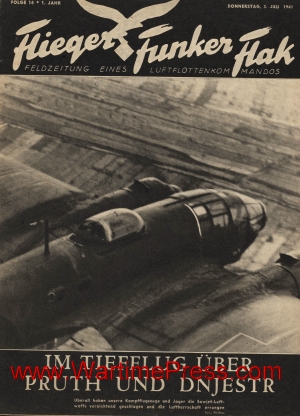
Description
Flieger · Funker · Flak
Donnerstag, 3. Juli 1941 · 1. Jahr · Folge 14
Feldzeitung eines Luftflottenkommandos — Feldpostnummer L 18500, Luftgaupostamt Wien
16 pages scanned. Instant PDF download.
Cover Page
Caption: “Im Tiefflug über Pruth und Dnjestr — Überall haben unsere Kampfflugzeuge und Jäger die Sowjet-Luftwaffe vernichtend geschlagen und die Luftherrschaft errungen” (“Flying low over the Prut and Dniester — everywhere our bombers and fighters have decisively defeated the Soviet air force and won air supremacy”)
Subject: A German twin-engine bomber (Heinkel He 111) seen from above in low-level flight over a river landscape near the Prut and Dniester.
Location: Prut and Dniester river region (Romanian–Soviet border area).
Photo credit: PK-Breu.
Major Headlines & Content
Über die Sowjet-Grenzen (Across the Soviet Borders) — Opening photo-spread on the launch of the campaign against the USSR on 22 June 1941: aircrews man MGs against flak and fighters while army units force border crossings on the ground below. Includes images of destroyed rail lines and bombed troop trains. Photo credits: PK-Breu, PK-Elle.
Unsere Waffenkameraden: Die Rumänen (Our Brothers-in-Arms: The Romanians) — Photo feature on Romanian and German airmen sharing airfields (Horst) and exchanging combat experience, ground crews arming Romanian bombers with fresh bombs for missions against the Soviets. A Romanian Oberleutnant shows his German comrades hits his aircraft took on a combat sortie. Photo credits: PK-Horster, PK-Breu, PK-Schubert.
Für das neue Europa (For the New Europe) — Feature package on Luftwaffe units fighting the Soviet Union: “Heinkel-Bomber über dem Schwarzen Meer” by Kriegsberichter Markus Joachim Tidick follows a bomber crew targeting the Soviet naval base of Sevastopol; “Bomben auf ein rotes Stabsquartier” describes a direct hit on a Soviet army headquarters; “Die Lufterrschaft errungen” by Kriegsberichter Anton Braeg covers combined German-Romanian air attacks on retreating Soviet columns, railway junctions, and troop concentrations near the Dniester and Black Sea. Author credits: Markus Joachim Tidick, Anton Braeg.
gegen die Sowjets! (Against the Soviets!) — War-correspondent reports: “Feindflug gegen Bahnanlagen und Flak” by Jochen Schulze recounts a mission against rail installations and flak positions near Czernowitz, in which a damaged Heinkel limps home; “Vernichtender Schlag gegen einen Sowjetflugplatz” by Cristoph von der Ropp describes a low-level strike destroying roughly half the aircraft on a Soviet airfield in the southern front sector. Place named: Czernowitz.
Notlandung auf russischer Erde (Emergency Landing on Russian Soil) — First-person account by Kriegsberichter Paul Klose of the bomber crew “Fritz-Marie” (pilot Hptm. W.) making an emergency landing 130 kilometres behind the Romanian–Soviet border after engine failure; the crew, including Leutnant K. and Leutnant F., is rescued by comrades from their Staffel and picks flowers on the Russian steppe while awaiting pickup.
Das Diplom der Tapferkeit (The Diploma of Bravery) — Light historical anecdote about a Paris balloon-ride attraction at the turn of the century, in which a nervous passenger receives a mock “diploma of courage” and turns out to be Graf Zeppelin. Named individual: Graf Zeppelin.
Other Content
Official report — Aus dem OKW-Bericht — daily Wehrmacht High Command communiqués for 24–30 June 1941, covering advances in the East, U-boat and Luftwaffe successes against Britain, and the award of the Ritterkreuz to Oberstleutnant Mölders.
Political news — Politik ganz kurz — short international items, 24–30 June 1941: reports on Italy joining the war against the USSR, unrest in the Baltics and among Don Cossacks, Sweden permitting German troop transit, the founding of a Norwegian Legion, Romanian Vice-Premier Mihai Antonescu also taking the foreign affairs portfolio, and France breaking diplomatic relations with the USSR.
Propaganda column — Plutokratischer “Brückenzoll” — satirical piece mocking British press and “plutocrats,” citing the Daily Mirror over a British factory owner charging workers a bridge toll to reach a damaged water supply.
Language column — Wie sag ich’s bloss? — a crash Romanian phrasebook for soldiers, giving air-raid-related phrases with pronunciation guides.
Humour column — Lachen aus dem Eff-Eff-Eff — short barracks jokes and cartoons, including gags about a strict Unteroffizier, a tiger hunt story, and a couple showing off a pram as “our own product.”
Puzzles — Treibstoff fürs Gehirn — a word-transformation puzzle (Kastor to Wonnen), a crossword (Kreuzworträtsel), and a homonym riddle; solutions to the previous issue’s puzzles are also printed.
Photo feature — Sowjetbomben auf Jassy — photographs of Soviet bombs having struck the Romanian city of Jassy (Iași), with damage to homes, streets, and a public square; also includes a portrait of a young Luftwaffe Ritterkreuz-Träger. Photo credits: PK-Horster, PK-von Kayser, PK-Meyer, Presse-Hoffmann, Scherl.
Photo feature — Für den Landser gesehen… — includes photographs of a public notice board in Constanța and of captured Soviet spies awaiting execution there after trial by Romanian authorities.
Photo feature — Die Schwerter zum Eichenlaub des Ritterkreuzes — the Führer awards the Swords to the Oak Leaves of the Knight’s Cross to Oberstleutnant Adolf Galland and Oberstleutnant Werner Mölders, the first two Wehrmacht officers so honoured; also pictured, Romanian head of state General Ion Antonescu inspecting German flak at Constanța, and a Fallschirmjäger regimental doctor decorated with the Iron Cross First Class by General der Flieger Kurt Student for his work on Crete. Named individuals: Adolf Galland (Oberstleutnant), Werner Mölders (Oberstleutnant), Ion Antonescu (General, Romanian head of state), Kurt Student (General der Flieger).
Photo feature — Ein buntes Rassengemisch: Gefangene Sowjets — photographs of captured Red Army soldiers described as being drawn from diverse ethnic backgrounds across the Soviet Union, including a European Soviet Unterführer and Unterleutnant and other prisoners identified as of Asian origin. Photo credits: PK-Jäger, PK-Cusian.