

Description
Evidence in Camera
Volume 7, Number 13, 24 July 1944 (Flying Bomb Issue)
Issued by the Air Ministry, A.C.A.S.(I), and printed by C. & E. Layton Ltd, London E.C.4. Marked Restricted (For Official Use Only), with a wartimepress.com copyright 2014 watermark.
21 pages (cover and inside covers, photo pages numbered 241–256, and one reduced duplicate of the “They Don’t All Reach England” spread)
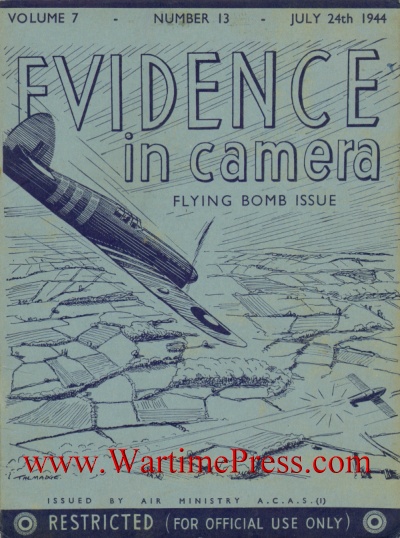
- Cover Illustration: A drawing of a fighter diving over a patchwork of English fields toward a flying bomb, under the words “Flying Bomb Issue”.
- A Flying Bomb Over England: An enlarged close-up of a jet-propelled V.1 rushing low over English countryside, which opens the issue’s record of the V.1 and V.2 campaigns.
- Peenemünde Launching Ramps: A vertical view of the Baltic experimental station, with launch ramps on reclaimed land pointing out to sea and two prototype flying bombs marked.
- Flying Bombs in Flight: Three small photographs of prototype flying bombs in the air, seen from above.
- Zinnowitz Launching Platform: A trial launch site set among trees just east of Peenemünde, where further experiments took place.
- The Original Flying Bomb Sites: A heavily cratered large site in the Pas de Calais, one of about 88, with its launching platform and three ski-shaped storage buildings, now abandoned after Allied bombing.
- Bois Carré Under Construction Inset: The Bois Carré prototype site photographed while it was being built.
- Abandoned Ski-Building Site: Another typical large installation, with its launching platform and ski buildings ringed by bomb craters, given up before it ever fired.
- Modified Type of Firing Point: A simpler site hidden in woods, with a short launching rail marked, of the kind now being used against England.
- Camouflaged Launch Point: A low oblique view of an orchard where camouflage hides the launching point when it is not in use.
- Flying Bomb on Launching Platform: A flying bomb sits at the foot of its ramp, ready to launch from a site so well hidden among trees that the control building can hardly be seen.
- Side View Over the Sea: A jet-propelled flying bomb seen side-on in flight over the sea.
- Fighter’s Cine-Gun Sequence: Three frames from an intercepting fighter’s camera showing the bomb from behind, its pulsing exhaust flame, and finally cannon shells bursting on the fuselage.
- They Don’t All Reach England: A two-page set of four vertical photographs of launch sites where flying bombs crashed and exploded just after take-off, with launching platforms, blast craters, unexploded bombs and skid marks labelled.
- Attacks on Flying Bomb Storage Dumps (Nucourt): Limestone caves used to store warheads, showing large areas of collapse and the cave entrances after Allied bombing.
- Biennais Attack Inset: A circular action shot of Bomber Command aircraft over another storage dump at Biennais.
- St. Leu d’Esserent Caves: A view of the former mushroom-growing caves, with wide areas of collapse and entrances sealed by direct hits and near misses.
- Lancaster Over a V.2 Target: A Lancaster flies above smoke rising from a heavily cratered target during the R.A.F. daylight attack of 6 July 1944.
- Bombing of the V.2 Rocket Installations: The Marquise Mimoyecques site turned into a cratered wilderness, with a very heavy bomb hit on its massive concrete structure.
- Mimoyecques Foundations Inset: The site’s foundations photographed before the final concrete protection was added.
- Halifax Over Siracourt: A Halifax flies over smoke and craters during the Bomber Command attack on the Siracourt V.2 site on the morning of 6 July 1944.
- Siracourt Construction Stages: Two vertical photographs showing the site being built and then roofed.
- Siracourt Oblique View: A low oblique view of the concrete structure surrounded by craters, with its roads and railways wiped out.
- Tempest Chasing a Flying Bomb: As a closing image, a Tempest fighter chases a flying bomb over the English countryside, trying to shoot it down into open fields.