

Description
DER SIEG
Armee-Zeitung
Nr. 170 · Im Mai 1944
Publisher not stated on scanned pages (German field army newspaper)
12 pages scanned. Instant PDF download.
Front-line army weekly, distinct from the Illustrierter Beobachter and Berliner Illustrierte Zeitung
Cover Page
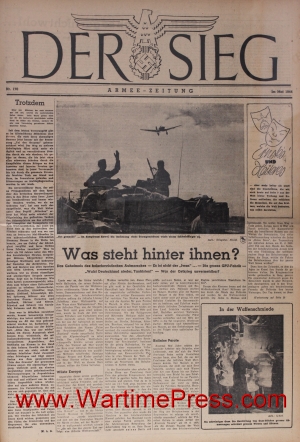
Caption: “Gut gemacht!” (“Well done!”)
Subject: Masthead page combining the paper’s title logo (eagle and swastika emblem) with the lead article „Trotzdem“ („Nevertheless“) on Allied terror bombing of Munich, and a photograph of a Sturmgeschütz (assault gun) crew waving to a German ground-attack aircraft.
Location: Kampfraum Kowel (combat zone of Kowel), Eastern Front.
Photo credit: Kriegsber. Etzold.
Major Headlines & Content
Was steht hinter ihnen? (What is behind them?) — Analysis of the Bolshevik advance and its origins, alleging Jewish control of the Soviet leadership and the GPU. Discusses Lenin, and the war’s inevitability given Bolshevik expansion. Locations: Moskau; continues onto page 2.
Sie fühlen sich so gar nicht wohl … (They feel not at all well …) — Report on Allied unease: the Empire Conference in London lacking direction, Sweden refusing to arm, and neutral states missing the moment for invasion pressure. Named: Winston Churchill.
Das sind sie! (These are them!) — Illustrated profile piece attacking Franklin D. Roosevelt’s inner circle as the men truly responsible for Allied war policy, framed as „Rasputin“ figures and „court jesters.“ Named with role: Harry Hopkins (presidential adviser), Newbold Morris, Leo Amery (British India minister), Cordell Hull (US Secretary of State), Edward Stettinius, Fiorello La Guardia (Mayor of New York), Thomas E. Dewey, Sir Robert Vansittart. Photo credits: Scherl, Kriegsber. Etzold, Ausl.
Rote Fackeln an der Turja (Red torches on the Turja) — Combat report on a German attack southwest of Kowel breaking through a deeply layered Soviet defensive system along the Turja river, told in three phases (morning, midday, evening). Named: Kriegsberichter Heinz Schnabel; Oberleutnant M., Hauptmann L. Photo credits: PK Leber, Mielke, Etzold.
Achtung! Feldpostnummer 12000! (Attention! Field post number 12000!) — Feature on the army office (Feldpostnummer 12000) that collects and develops soldiers’ suggestions for improving weapons and equipment, in place since April 1942.
Other Content
Fiction serial — “Marie und ihre Liebhaber” by Josef Martin Bauer. A village maid, Marie, is courted by several suitors including Peter and Karl and comes into the orbit of the older Balthasar Münjeman; set in a rural farming community.
Fiction — “Junge Menschen” by Bruno Brehm. Story centred on the young Marieschen and her friend Susanne, and the youth Herbert who becomes entangled with them.
Fiction — “Das doppelte Dornröschen” by Hans Jüngst. A schoolteacher, Frau Evers, casts two of her pupils, Anna and Irene, in rival roles in a school production of Sleeping Beauty.
Humour column — “Zarte Briefe für Ursula” by Fritz Gunthen. Comic short story of romantic letters written to Ursula by a man named Karl.
Anecdote feature — “Die heitere Maske” — theatre anecdotes told by Wilhelm von Scholz, covering actors and playwrights including Ferdinand Bonn and Bernard Poussart.
Feature article — “Leonardo da Vinci — Der faustische Italiener.” Illustrated feature on Leonardo’s life and work, quoting Jacob Burckhardt and Dr. Richard Biedrzynski, with reproductions of his drawings and the Mona Lisa.
Cartoon spread — “Die Panje Hütte,” verses by Fw. Kurt Preis, drawings by Obgefr. Max Moritz.
Humour column — “O Du kriegst die Tür nicht zu” — short jokes and cartoon gags, text by Hans B. Wagenseil, illustrations by Vanhusen.
Photo feature — “Frauen — schön und schleierhaft,” a spread of veiled women film stars. Photo credits: Terra, UFA, Tobis.
Puzzles — “Zum Kopfzerbrechen” — riddle and word puzzles.