

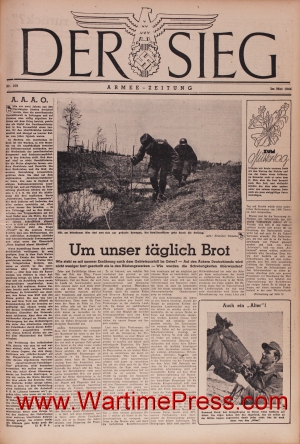
Description
DER SIEG
Armee-Zeitung
Nr. 169 · Im Mai 1944
12 pages scanned. Instant PDF download.
Cover Page
Caption: “HKL am Bahndamm. Hier darf man sich nur geduckt bewegen. Der Bataillonsführer geht durch die Stellung.” (“Main line of resistance at the railway embankment. Here one may only move stooped over. The battalion commander walks through the position.”)
Location: Eastern Front.
Photo credit: Kriegsber. Tiemann, PK.
Photo: Jager and his horse
Major Headlines & Content
Um unser tägliches Brot (About our daily bread) — Report on Germany’s food supply following the loss of eastern territories, describing efforts by farms and the war-production sector to make up the shortfall and how difficulties in grain, fat, and vegetable supply are being managed.
„Wieviele kommen zurück?“ (“How many will come back?”) — Piece on British unease ahead of a Dominions conference, arguing the „British lion“ no longer roars and that England is losing standing with the Dominions and the neutrals. Names Winston Churchill; references Cairo and Washington.
Das Lächeln der Mütter (The mothers’ smile) — Sentimental feature on soldiers’ mothers seeing their sons off at the station and awaiting their return, illustrated with a mother-and-child photograph and a soldier reading a letter in the field. Photo credits: Robert Weber, Tiemann-PK.
Der Kampf um Kowel (The battle for Kowel) — Overview report by Major Dr. J. Schäfer on the successful German defence of Kowel against Soviet encirclement attempts between 16 and 19 March, with a map of the fighting around the town and along the Wyzwa Nowa and Turja. Places: Kowel, Brest-Litowsk, Ratno. Photo credit: Kriegsberichter Wolfgang Etzold.
Das Hindenburglicht (The Hindenburg light) — First-person account by war correspondent H. J. Hüntemann of a night in a front-line bunker under artillery fire near Kowel, describing the crew’s improvised lamp made from a shell case.
Other Content
Fiction — “Cäcilie” by Felix Timmermans. Romantic story of a young woman, Cäcilie, and her suitor Ruland, whose broken promise and remorse drive the plot.
Fiction — “Die Hochzeit des Verurteilten” by Paul Ernst. Tale set at the Stockholm royal court of two young lovers, Ritterschwert and Fräulein Palmschild, condemned amid courtly intrigue.
Feature article — “O Straßburg, o Straßburg…” by Grenadier Erich Traumann. Illustrated cultural and historical portrait of Strasbourg, its cathedral, half-timbered houses, and old town. Photo credits: Scherl.
Humour column — “Kuckucks-Duell” by Roderich Menzel. Comic short story about a tennis rivalry and a mistaken newspaper interview.
Humour column — “Der Trick” by Heinrich Rumpff. Comic story involving a magician, Tonio, and a nightclub conjuring trick gone wrong.
Humour column — “Man kann ja mal dumm fragen” — short jokes and cartoons, including a piece by Eugen Roth.
Photo feature — “Schöpferische Hände” — portraits of German sculptors at work, including Professor Georg Kolbe, Professor Richard Scheibe, Professor Fritz Klimsch, and Professor Josef Thorak. Photo credits: Scherl.
Cartoon spread — “Die Panje Hütte,” Kapitel 7, continuing verse-and-drawing serial about front-line quarters.
Column — “Zwischen zwei Wachen” — soldiers’ life column including Oberstleutnant a. D. Renary on wartime marriages and a “Soldbuch-Klappe” reader-photo feature.
Reader competition — “Das Kesseltreiben in vollem Gange” — update on the paper’s “Muniklau” reader submission contest, with cartoons and prize announcements.
Puzzles — “Zum Kopfzerbrechen” — crossword-syllable puzzle (“Kreuzwort-Silbenrätsel”) and riddles.