

Description
Der Sieg
Im März 1944 · Nr. 160
12 pages scanned. Instant PDF download.
Cover Page
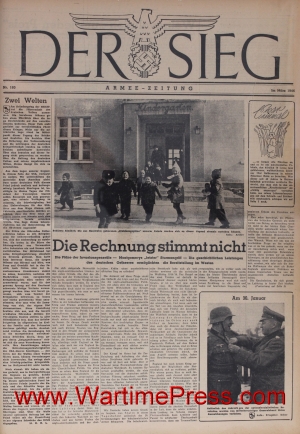
Caption: „Kindergarten. Behütete Kindheit. Die aus Haßwahn geborenen ‘Erziehungspläne’ unserer Feinde werden sich an dieser Jugend austoben können.” (“Kindergarten. Sheltered childhood. The ‘education plans’ born of our enemies’ hate-fuelled fantasies will be unleashed on this generation.”)
Subject: German children playing and walking outside a kindergarten building, illustrating an editorial (“Zwei Welten”) on Nazi Party Foundation Day contrasting German and Allied leadership and war-production confidence.
Photo credit: Aufn.: Archiv.
Major Headlines & Content
Die Rechnung stimmt nicht (The Reckoning Doesn’t Add Up) — Lead front-page essay dismissing Allied invasion planning and “Montgomery’s final assault,” arguing that the German Ostheer’s (Eastern Army’s) historic performance freed up forces for deployment in the West. Includes a sidebar, „Am 30. Januar,” with a photo of Ritterkreuzträger being decorated by Generaloberst Weiß on the anniversary of the National Socialist “revolution.” Continues on page 2. Photo credit (medal photo): Kriegsberichter Rebor.
Das gelbe Chikago (The Yellow Chicago) — Illustrated feature on organized crime, opium trafficking, and gang violence in wartime Shanghai, framed as the city having been cleaned up under Japanese-backed order. Subsections: „Volksfeind Opium” (Opium, Enemy of the People) and „Attentate, Raub, Mord” (Assassinations, Robbery, Murder). By Erich Winter.
Meister Meergans führt! Ein Schibataillon im Gegenstoß (Master Meergans Leads! A Ski Battalion Counterattacks) — Front-line combat report on a German ski battalion’s night counterattack against Soviet forces in the forests along the Pripet, describing patrol movement, a surprise raid on a village, and close combat. Photo credits: Kriegsberichter Tiemann, Kriegsberichter Leher, Kriegsberichter Rebor, Kriegsberichter Justus Erkhardt.
Other Content
Political commentary — Was ist in der Welt passiert? (What Has Happened in the World?) — Short items including „Demokratisches Prinzip” (criticizing the Atlantic Charter as hypocritical) and „Bilanz in Italien” (Balance Sheet in Italy) by Major R. Röser, on the limited Allied territorial gains in Sicily and mainland Italy since the 1943 landings.
Political feature — Weltrevolution „um jeden Preis” (World Revolution “at Any Price”) — Anti-Bolshevik history of the Comintern and world revolutionary movements from 1918 to the wartime present, with a timeline of uprisings in Germany, Hungary, Bulgaria, Spain, and elsewhere. Includes short companion pieces „Der Völkerbund,” „Treu im Glauben,” and a miscellany column „Kurz betrachtet” covering Allied and Soviet propaganda topics.
War feature — Kirisini: „Letzter Angriff bis zum Tode” (Kirisini: “Last Attack to the Death”) — Account of Japanese military conduct in a Pacific island battle, centred on the Inagaki detachment and Feldwebel Kaimuna, presented as an example of Japanese fighting spirit.
Maps feature — Weißt Du Bescheid? Atlas der Fronten und der neuen Grenzen (Do You Know? Atlas of the Fronts and the New Borders) — A set of reference maps covering the Eastern Front around the Pripet Marshes, Scandinavia, Britain/France/the Reich, the Balkans (including “Das neue Bulgarien”), and the Pacific theatre.
Humor/anecdote column — Zwischen zwei Wachen (Between Two Watches) — Soldiers’ anecdotes and humor, including „Die ‘Rattia’ im Türkischen Café” by Gefreiter Leo Jankowski, „Ritter unter dem Helm,” „Der Kapitän,” „Da rollte die Platte” by Hans H. Reinhard, and a Bismarck anecdote titled „Ganz einfach: ‘Otto, Otto’…”
War feature — Räder rollen für den Sieg (Wheels Roll for Victory) — Short report on supply-transport columns bringing new material to the Eastern Front.
Illustrated memoir — Es war einmal (Once Upon a Time) by Olaf Gulbransson — Autobiographical cartoon feature, “from the memoirs of a master of the pen,” including a section „1902: Über Berlin nach München” recalling the artist’s move to Munich.
Feuilleton page — Meister der kleinen Form (Masters of the Short Form) — A page of short stories by leading German feuilletonists: Sigismund von Radecki (“Eilige Geschichte”), Walter Foitzik (“Der Stammkunde”), Ernst Kammerer (“Der Schubkarren”), Viktor Auburtin (“Die Milchstraße und das Kind”), and Bruno Brehm (“Heimat”); with a poem by Joachim Ringelnatz.
Film feature — Herr Sanders lebt gefährlich (Mr. Sanders Lives Dangerously) — Promotional feature on the Tobis film, describing a harbour-tavern scene starring Paul Verhoeven and Paul Henckels.
Fiction/short stories — Ansitz auf Hasen (Waiting for Hares) by Sigismund von Radecki, a hunting story; “Die Mausefalle,” a poem by Christian Morgenstern; “Die Hochzeitsreise”; “Letzte Szene des Liebhabers” by Hans Karl Breslauer; and “Netter Abend mit Verspätung” by I. H. Harrer; plus a box of Chinese proverbs.
Humor page — Ein hohler Zahn voll Witze (A Hollow Tooth Full of Jokes) — Jokes and cartoons, including the poem „Zahnschmerzliche Nacht” by Michel Mumm.
Puzzles — Zum Kopfzerbrechen (For Racking Your Brain) — A crossword (Kreuzwort-Rätsel) and a syllable puzzle (Silbenrätsel), with the solution to the previous puzzle printed.
Feature — Verse auf den ersten Blick (Verses at First Sight) — A page of four studio portrait photographs of women, each paired with a short poem; photo credits: Terra, Tobis, Ufa, and Wien-Film; verse by Sladelhofer.