

45th Infantry Division

45th Infantry Division — “Thunderbird Division”
Shoulder Patch: Golden Thunderbird — an American Indian symbol for the sacred bearer of unlimited happiness — against a red diamond representing ancient Spanish color.
Motto: Semper Anticus — Always Forward
Overview Activated in 1924 and inducted September 16, 1940 at Fort Sill, Oklahoma. Trained at Camp Barkeley, Fort Devens, Camp Edwards, Pine Camp and Camp Pickett before deploying to North Africa in June 1943.
Component Units (as of June 1943) 157th, 179th and 180th Infantry Regiments — 158th, 160th, 171st (L) and 189th (M) FA Battalions Higher Command: Seventh Army
Combat History The Thunderbird Division earned the distinction of four D-Days — Sicily, Salerno, Anzio and Southern France. Landing in Sicily on July 10, 1943, the 45th captured Motta Hill — “Bloody Ridge” — in four days. At Salerno after 46 days of bitter fighting the division crossed the Volturno and fought 73 days more. Going ashore at Anzio on January 22, 1944, the Thunderbirds spent four months keeping the Nazis from driving the Americans into the sea before breaking through the Anzio ring and sweeping north of captured Rome.
Landing in Southern France on August 15, 1944, the 45th spearheaded the drive for Belfort Gap, crossed the Moselle, fought through the Vosges foothills and crossed the Meurthe. Pushing through the Maginot defensive belt and into the Lembach-Wingen Valley the division moved to Saarguemines in March 1945. Final actions included the Saar district, Rhine crossing at Wurms, Aschaffenberg, Nurnberg, the Danube crossing, liberation of the Dachau victims and the march on Munich. The division served 511 combat days.
Awards Distinguished Unit Citation to Co. I, 157th Infantry Regiment for action near Carroceto, Italy, February 17-21, 1944 — DUC to 2nd Battalion, 157th for action in Italy, February 1944 — DUC to Co. G, 180th for action near Padiglione, Italy, February 18, 1944 — Croix de Guerre with Palm to the entire division, July 2, 1945
Commanding Generals Maj. Gen. William S. Key through Maj. Gen. Troy H. Middleton, Maj. Gen. William W. Eagles and Maj. Gen. Robert T. Frederick through the end of the war.
Showing all 7 results
-
 Pre-Order
179th Infantry Regiment 45th Division (PDF)
$19.95 Add to cart -

180th Infantry Regiment, 45th Infantry Division, WWII (PDF)
$19.95 Add to cart -
 Pre-Order
45th Infantry Division – History of the 180th Infantry Regiment (PDF)
$19.95 Add to cart -
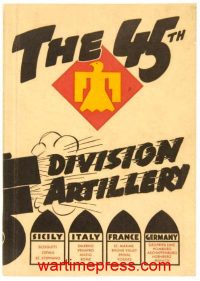
The 45th Division Artillery (PDF)
$19.95 Add to cart -

Forty Fifth Infantry Division (PDF)
$19.95 Add to cart -

45th Infantry Division – History of the 157th Infantry Regiment (PDF)
$19.95 Add to cart -
 Pre-Order
158th Regimental Combat Team (PDF)
$19.95 Add to cart